
Choosing products for an Amazon FBA wholesale business is not simply about finding items with a high selling price or an attractive profit margin. A product may appear profitable but still create problems if the category is restricted, the competition is too strong, the inventory moves slowly, or the supplier cannot provide proper sourcing documents.
For wholesale sellers, the right category should offer a balance of customer demand, manageable competition, reliable supply, reasonable storage costs, and clear documentation.
The “best” category will therefore be different for every seller. A beginner with limited capital may prefer small, lightweight, non-fragile products, while an experienced seller may be prepared to manage expiration dates, compliance documents, larger minimum orders, or brand approval requirements.
Quick Answer
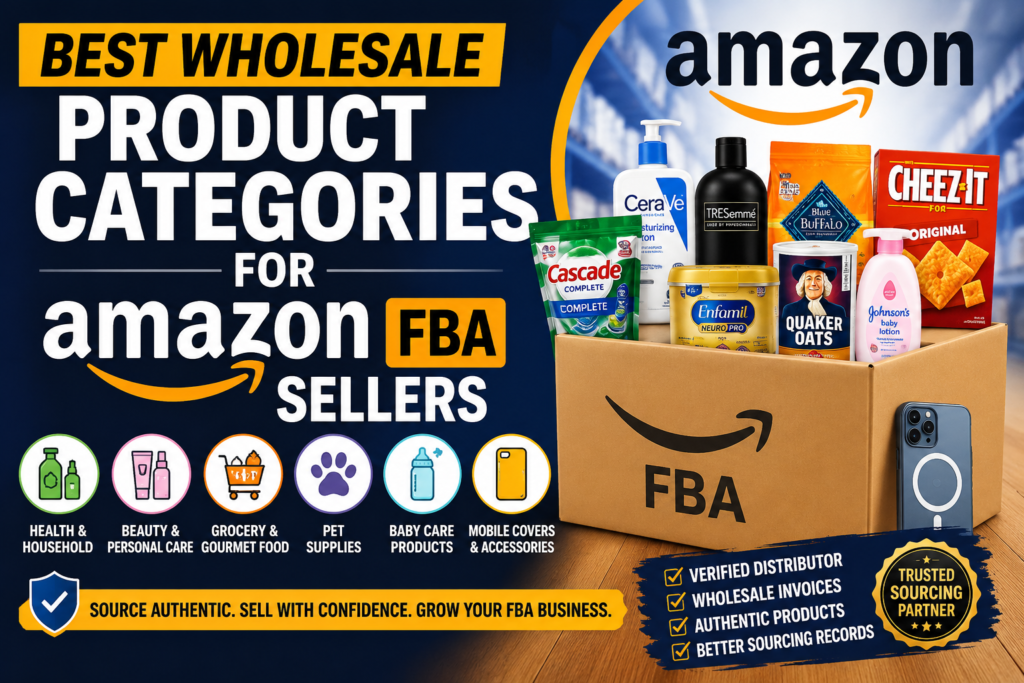
The best wholesale product categories for Amazon FBA sellers often include:
- Health & Household
- Beauty & Personal Care
- Grocery & Gourmet Food
- Pet Supplies
- Baby Care Products
- Mobile phone covers and accessories
However, sellers should not select a category based only on popularity. Before purchasing inventory, check your selling eligibility, Amazon restrictions, product demand, competition, fees, expiration requirements, supplier documentation, and expected profit.
Some products and categories may require Amazon approval, supporting invoices, compliance records, or brand authorization. Requirements may vary by category, product, seller account, and marketplace.
What Makes a Wholesale Product Category Suitable for Amazon FBA?
A good Amazon FBA wholesale category gives sellers access to products that can be sourced consistently and resold with a realistic margin.
It should also fit the seller’s available capital, storage capacity, experience, and tolerance for compliance requirements.
AI Snippet Answer
What makes a good Amazon FBA wholesale category?
A good wholesale category has consistent demand, manageable competition, reliable suppliers, acceptable Amazon fees, clear product documentation, and enough profit after all costs. Sellers should also confirm that they are eligible to sell the selected products before ordering inventory.
Before choosing a category, consider the following:
- Is there consistent customer demand?
- Can the products be reordered from the same supplier?
- Is Amazon already selling the product?
- How many FBA sellers compete on the listing?
- Is the Buy Box price stable?
- Does the product require approval?
- Is the item fragile, oversized, meltable, hazardous, or expiration-dated?
- Can the distributor provide a detailed wholesale invoice?
- Does the final profit justify the investment?
Amazon also provides tools such as Product Opportunity Explorer, which allows sellers to review search demand, competition, pricing, customer reviews, purchasing behavior, and return activity. These tools can support product research, but they do not guarantee that a product will succeed.
Best Wholesale Product Categories for Amazon FBA
The following categories can offer useful opportunities for wholesale sellers, depending on product availability and Amazon’s current requirements.
1. Health & Household
Health & Household includes a wide range of everyday-use products, such as personal care essentials, household supplies, wellness accessories, cleaning products, and selected health-related items.
One advantage of this category is the possibility of repeat purchasing. Customers regularly replace household and personal-use products, which may create steady demand for established brands.
However, this category also requires careful research. Some items may be restricted, regulated, classified as dangerous goods, or subject to documentation requirements. Certain health products may require invoices, authorization, safety records, or additional compliance information.
Before buying Health & Household inventory:
- Check whether you are eligible to sell the ASIN.
- Review the product’s ingredient and safety information.
- Confirm whether the item is classified as dangerous goods.
- Check expiration dates where applicable.
- Verify that the supplier invoice clearly identifies the product.
- Avoid making medical or unsupported product claims.
This category may be better for sellers who are willing to perform detailed compliance checks before placing an order.
2. Beauty & Personal Care
Beauty & Personal Care is another popular wholesale category because it includes products customers may purchase repeatedly, such as skincare, haircare, grooming, bath, and personal hygiene products.
Established beauty products can attract strong customer interest, but competition may also be high. Sellers should study each ASIN individually instead of assuming every well-known beauty product will be profitable.
Some beauty products may require category or product approval. Amazon may request invoices, product images, ingredient details, brand authorization, or other documentation depending on the product and application.
Important checks include:
- Product condition and packaging
- Expiration or period-after-opening information
- Leakage risk
- Meltable-product restrictions
- Brand restrictions
- Listing accuracy
- FBA preparation requirements
- Authenticity documentation
Beauty sellers should also avoid purchasing products with damaged packaging, old packaging versions, missing seals, or unclear batch information.
3. Grocery & Gourmet Food
Grocery & Gourmet Food may offer repeat-purchase opportunities because many products are consumed and reordered. Examples can include packaged foods, snacks, drinks, pantry items, and specialty grocery products.
However, grocery inventory requires stronger stock management than many non-consumable categories.
Food is generally treated as date-sensitive, and applicable products must show expiration information. Sellers need enough remaining shelf life to meet Amazon’s requirements and provide customers with usable inventory.
Before purchasing grocery products, check:
- Remaining shelf life
- Expiration-date format
- Temperature sensitivity
- Seasonal demand
- Packaging strength
- Leakage or breakage risk
- Case-pack quantity
- FBA preparation requirements
- Storage and fulfillment fees
Avoid placing a large grocery order simply because the unit cost is low. Inventory that expires before it sells can quickly turn an apparently profitable deal into a loss.
4. Pet Supplies
Pet Supplies can be attractive because many pet owners regularly reorder food, treats, grooming products, cleaning supplies, and other everyday pet-care items.
The category contains both consumable and non-consumable products, giving sellers different sourcing options. However, pet products should still be evaluated for restrictions, ingredients, expiration dates, safety information, and brand approval requirements.
Depending on the product, an approval application may request invoices, brand authorization, product photographs, safety certifications, or regulatory documents.
For beginners, simpler non-consumable pet accessories may be easier to evaluate than regulated treatments, supplements, or animal-health products.
A good pet-supply opportunity should have:
- Clear product identification
- Stable customer demand
- Strong packaging
- Reasonable dimensions and weight
- Reliable replenishment
- Manageable seller competition
- Proper supplier documentation
5. Baby Care Products
Baby Care can include feeding accessories, hygiene products, grooming items, nursery essentials, and everyday care products.
Parents often prioritize quality, safety, packaging, and product condition, so sellers must be especially careful when matching inventory to an Amazon listing.
Check the following before purchasing:
- Product safety information
- Age recommendations
- Packaging condition
- Expiration dates where relevant
- Recall history
- Model or variation details
- Pack size
- Listing images and descriptions
- Category restrictions
Do not list a baby product against an ASIN unless the brand, model, size, pack quantity, and packaging match correctly.
6. Mobile Phone Covers and Accessories
Mobile phone covers and selected accessories can be easier to store and ship because many products are lightweight and compact.
This category may appeal to sellers who want to avoid expiration-dated inventory. However, it can also have intense price competition, frequent model changes, and a high risk of purchasing inventory that becomes outdated.
Before ordering mobile accessories, verify:
- Exact phone model compatibility
- Brand and model restrictions
- Current demand
- Number of competing sellers
- Product dimensions
- Return rates
- Packaging quality
- Whether batteries are included
- Listing variation accuracy
Simple phone covers may be easier to manage than electronic accessories containing batteries, chargers, or components with additional compliance requirements.
Why Category Selection Matters for Amazon FBA Sellers
Selecting the wrong category can lock money into products that are difficult to sell, restricted, expensive to store, or unsupported by proper documents.
A suitable category can make the business easier to manage by providing:
- More predictable replenishment
- Better inventory planning
- Clearer product research
- More organized supplier relationships
- Lower risk of mismatched listings
- Better sourcing documentation
Category selection also affects your operating process. Grocery sellers must manage shelf life, beauty sellers may need to monitor leakage and packaging, and mobile-accessory sellers must track changing device models.
The best category is not always the one with the highest demand. It is the one your business can source, document, store, and sell responsibly.
Step-by-Step Guide to Choosing a Wholesale Category
Step 1: Check Your Amazon Selling Eligibility
Search for the exact product in Seller Central before purchasing inventory.
If you see “Apply to Sell,” review the application requirements first. Do not assume that a supplier invoice will automatically provide approval.
Approval decisions remain subject to Amazon’s review, and requirements may vary by product, category, marketplace, and account.
Step 2: Research Demand and Competition
Review more than the product’s sales rank.
Study:
- Price history
- Buy Box stability
- Number of FBA sellers
- Amazon’s presence on the listing
- Estimated monthly sales
- Review activity
- Seasonal changes
- Offer count
- Customer complaints
- Return-related concerns
A high-demand listing may still be a poor opportunity when too many sellers are competing for the same sales.
Step 3: Calculate the Complete Cost
Your purchase price is only one part of the total cost.
Include:
- Wholesale unit cost
- Shipping to your location or prep center
- Preparation and labeling
- FBA fulfillment fees
- Storage fees
- Referral fees
- Inbound placement or shipment costs
- Returns and damaged units
- Software and operating expenses
Calculate profit using a realistic selling price, not only the highest price currently shown on the listing.
Step 4: Verify the Supplier
Confirm that the supplier operates as a traceable business and can provide accurate wholesale documentation.
Review the company’s:
- Legal business information
- Address and contact details
- Website
- Product categories
- Invoice format
- Payment methods
- Return policy
- Brand relationships where available
Our previous guide on how to avoid fake wholesale suppliers for Amazon FBA explains the warning signs sellers should review before sending payment.
Step 5: Confirm the Invoice Details
Ask what information will appear on the invoice before placing the order.
A useful invoice should clearly identify the buyer, supplier, products, quantities, invoice date, and transaction details.
For a complete checklist, read our previous article on wholesale invoicing for Amazon sellers.
A wholesale invoice may help support approval requests or authenticity reviews, depending on Amazon’s requirements, but it does not guarantee approval.
Step 6: Start With a Manageable Order
Avoid placing a large first order simply to receive a lower unit price.
A smaller test order can help you evaluate:
- Actual sales speed
- Price changes
- Packaging quality
- Prep requirements
- Customer returns
- Supplier service
- Reordering reliability
Once the product performs consistently, you can consider a larger reorder based on updated research.
Step 7: Keep Complete Sourcing Records
Save the original invoice and supporting documents in an organized folder.
Keep:
- Purchase orders
- Commercial invoices
- Payment records
- Shipping documents
- Tracking information
- Product photos
- Supplier emails
- Authorization documents where available
- ASIN and SKU information
As discussed in our guide to product authenticity on Amazon, a seller should be able to explain where the inventory came from and provide supporting records when requested.
Common Product-Category Mistakes to Avoid
Choosing a Category Only Because It Is Popular
A popular category can also have aggressive competition, unstable pricing, and higher advertising costs.
Buying Before Checking Restrictions
Always confirm that you can sell the exact ASIN before placing a wholesale order.
Ignoring Expiration Dates
Expiration-dated inventory requires careful purchasing, receiving, storage, and replenishment planning.
Focusing Only on Revenue
Strong revenue does not always mean strong profit. Calculate every cost before making a buying decision.
Purchasing the Wrong Variation
A small difference in size, flavor, color, count, compatibility, or packaging can make the product unsuitable for the selected listing.
Ordering Too Much Inventory
Large orders increase risk when sales estimates are inaccurate or the Buy Box price falls.
Accepting Weak Supplier Documentation
A low price should not be more important than product authenticity, supplier traceability, and accurate invoices.
How a Verified Wholesale Distributor Can Help
A reliable wholesale distributor can make category selection and inventory sourcing more organized.
A professional distributor may help sellers by providing:
- Clearly identified product categories
- Commercial wholesale invoices
- Consistent business information
- Product and case-pack details
- Minimum-order information
- Shipping records
- Brand or product documentation where available
- A clear account-opening process
Nations Distributor currently presents wholesale categories including Health & Household, Beauty & Personal Care, Grocery & Gourmet Food, Baby Care, Pet Supplies, and mobile covers.
Before opening an account, sellers can learn more about the company through the Nations Distributor About Us page and review the available information on the Nations Distributor website.
The wholesale application asks for business, tax, resale, billing, shipping, and industry information as part of the account-opening process.
Working with a structured distributor does not guarantee Amazon approval or product profitability. However, it can help sellers maintain better sourcing records and purchase through a more organized business-to-business process.
Final Thoughts
The best wholesale product categories for Amazon FBA are not determined by popularity alone.
A suitable category should match your capital, experience, risk tolerance, account eligibility, and ability to manage inventory. It should also give you access to products with realistic demand, manageable competition, accurate listings, acceptable costs, and traceable sourcing documentation.
Health & Household, Beauty & Personal Care, Grocery, Pet Supplies, Baby Care, and mobile accessories can all offer opportunities. Each category also has different risks and operating requirements.
Research every ASIN individually, verify the supplier, calculate the full cost, confirm Amazon requirements, and begin with a manageable order.
Ready to explore wholesale sourcing opportunities? You can apply for a wholesale account, review the product categories available through Nations Distributor, or contact the distributor with questions about products, invoices, account requirements, and availability.
Frequently Asked Questions
1. What is the best wholesale category for a beginner Amazon seller?
There is no single best category for every beginner. Small, lightweight, non-fragile, non-expiring products may be easier to manage, but sellers must still check demand, competition, restrictions, fees, and supplier documentation.
2. Do wholesale products require Amazon approval?
Some products, brands, and categories may require approval, while others may be open to eligible sellers. Check the exact ASIN in Seller Central before purchasing inventory.
3. Can a wholesale invoice help with Amazon ungating?
A complete invoice from a manufacturer or distributor may help support an approval request, depending on Amazon’s requirements. It does not guarantee category, brand, or product approval.
4. How do I know whether a wholesale product is profitable?
Subtract the product cost, shipping, preparation, Amazon fees, storage, returns, and other operating expenses from a realistic selling price. Also review competition and price history before ordering.
5. Should I sell in multiple wholesale categories?
New sellers may benefit from learning one category before expanding. Selling in multiple categories can diversify inventory, but it also increases research, compliance, purchasing, and recordkeeping responsibilities.