
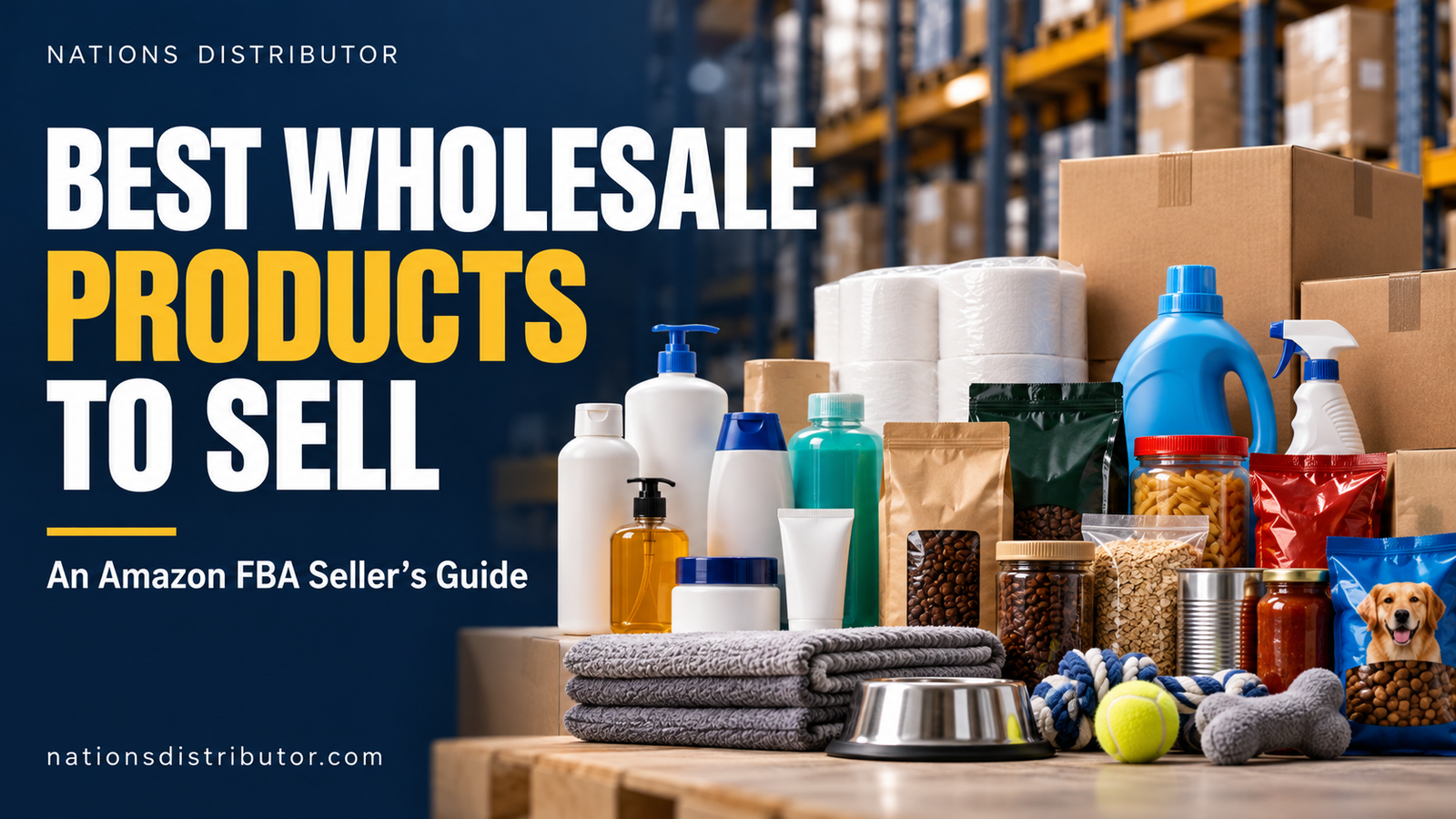
Finding the best wholesale products to sell starts with a practical question: can you purchase an item at a price that leaves enough profit after selling expenses?

A recognizable brand or attractive bulk discount is only part of the decision. Amazon FBA sellers also need to evaluate demand, competition, selling eligibility, inventory turnover, and fulfillment costs before placing an order.
The right product selection depends on your budget and business goals. Some sellers focus on everyday essentials, while others build a catalog around beauty products, grocery items, or pet supplies.
This guide explains which product categories to research, how to evaluate wholesale opportunities, and what to check before committing to inventory.
What Makes a Wholesale Product Worth Selling?
The strongest wholesale opportunity combines customer demand with manageable costs and reliable sourcing. A product should fit your selling account, purchasing budget, and restocking capacity.
Look for these qualities when researching wholesale products for Amazon FBA:
- Demand that continues beyond a short-lived trend.
- A purchasing price that supports realistic margins.
- Competition you can assess before ordering.
- Packaging suitable for economical storage and shipping.
- Clear product identification and sourcing documentation.
- Replenishment options that match your sales pace.
Avoid judging products by revenue alone. An item can generate substantial sales while leaving little profit after inventory, fulfillment, shipping, and other expenses.
Your objective is to build a repeatable purchasing process rather than chase whichever product looks popular today.
Best Wholesale Product Categories to Research
The following categories provide useful starting points. These are research opportunities, not a ranking of guaranteed winners.
1. Health and Household Products
Health and household products cover many everyday needs, making this category worth exploring for a replenishable inventory strategy.
Research ideas include household maintenance products, cleaning accessories, air freshener refills, and other practical essentials. Evaluate each item separately because products within the same category can have very different costs and requirements.
Start with the Health & Household wholesale category to identify items for further research.
Compare package dimensions, shipping weight, product condition, and any special handling needs. Liquids, chemicals, and products with health-related claims deserve additional review before purchasing.
Small, straightforward items can be easier to evaluate than products requiring complex preparation or expensive shipping.
2. Beauty and Personal Care Products
Beauty and personal care is another category to explore when building an Amazon wholesale catalog.
Potential research areas include grooming accessories, personal care essentials, hair care products, and skincare items. However, brand recognition alone does not establish that an item will be profitable.
Browse the Beauty & Personal Care category and create a shortlist based on your account’s eligibility and sourcing budget.
Check packaging condition, seals, expiration information where applicable, and exact listing details. Confirm that the product you purchase matches the brand, size, quantity, and variation advertised on Amazon.
Clear product matching helps prevent avoidable customer complaints and inventory errors.
3. Grocery and Gourmet Food
Grocery products offer another route for sellers researching repeat-purchase items.
Coffee, packaged candy, snacks, and other shelf-stable foods are examples to investigate. Their suitability depends on shelf life, packaging, competition, and the time needed to sell your order.
Explore the Grocery & Gourmet Food wholesale category for possible sourcing ideas.
Before ordering, request expiration dates and review the current requirements for your exact product. Consider whether inventory could spend time in transit, awaiting processing, or sitting unsold.
A low wholesale price offers little value if too much stock becomes unsellable before customers purchase it.
4. Pet Supplies
Pet supplies can support a focused catalog built around a particular customer need or animal type.
Research ideas include grooming accessories, everyday care products, and suitable pet consumables. Compare the exact product’s demand, package size, listing competition, and storage requirements.
Avoid assuming every animal-related product has the same selling conditions. Veterinary products, treatments, and other specialized items can require additional checks.
For an initial shortlist, prioritize products you understand well enough to assess accurately. Review product identification, sourcing records, and fulfillment suitability before committing to a bulk purchase.
A focused selection is often easier to manage than a large catalog of unrelated pet products.
5. Baby Care Essentials
Baby care is a possible research category for sellers who can carefully evaluate product suitability and documentation.
Everyday accessories may provide ideas, but products intended for babies require particular attention to condition, packaging, safety information, and applicable requirements.
Choose items you can verify thoroughly. Check the exact model, product identifiers, and listing details rather than relying on a broad description from a supplier.
Avoid buying unfamiliar products simply because a listing appears to have strong demand.
For any category, confirm your selling eligibility and review applicable Amazon requirements before purchasing inventory. Some products, brands, and categories require approval. Sell on Amazon
How to Find Profitable Wholesale Products for Amazon FBA
Study Demand Over Time
Begin by reviewing the product’s sales and pricing patterns rather than relying on a single snapshot.
A temporary promotion or seasonal event can make an item appear more attractive than it is throughout the year. Look for evidence that customer interest continues outside those periods.
Amazon identifies tools such as Product Opportunity Explorer as resources for product research. Use research tools alongside supplier information to build a more complete picture of an opportunity. sell.amazon.com
Review Listing Competition
Check how many sellers offer the exact item and whether pricing remains relatively stable.
An established listing may already have strong competitors. If several sellers repeatedly reduce prices, your projected margin could disappear after inventory arrives.
Consider your ability to compete on the existing listing. Calculate profit using a conservative selling price instead of the highest price you can find.
Match the Product Exactly
Wholesale product research should happen at the individual item level.
Confirm the UPC, model, size, color, quantity, and pack configuration. A single unit, manufacturer multipack, and wholesale case are different purchasing and selling units.
If a supplier quotes a case price, divide it by the number of sellable units before comparing costs.
Never assume a case can be sold under an existing multipack listing without checking that the contents match.
Calculate Costs Before Buying in Bulk
A wholesale discount becomes useful only when the final numbers support your business.
Estimate the following costs:
- Inventory purchase price.
- Supplier shipping.
- Preparation and labeling.
- Transportation into fulfillment.
- Amazon selling and fulfillment fees.
- Storage and other applicable charges.
- Returns, advertising, and operating expenses.
Amazon’s Revenue Calculator lets sellers compare estimated costs and proceeds for FBA and their own fulfillment method. Use accurate product dimensions, weight, and cost inputs when reviewing an opportunity. Sell on Amazon
An Illustrative Profit Example
Suppose an item sells for $25, and your estimated expenses are:
| Expense | Cost per unit |
|---|---|
| Wholesale purchase | $10.00 |
| Shipping and preparation | $2.00 |
| Amazon selling and fulfillment fees | $8.00 |
| Other allocated expenses | $1.00 |
| Total estimated cost | $21.00 |
| Estimated profit | $4.00 |
The estimated margin is 16% of the selling price.
These figures are hypothetical. Recalculate with the actual product’s costs, and test what happens if the selling price falls or expenses increase.
Choose a Wholesale Supplier Carefully
Product selection and supplier selection should work together.
Ask prospective wholesale suppliers for clear information about product identifiers, order quantities, pricing, available inventory, documentation, shipment arrangements, and damaged-item procedures.
Written answers make it easier to compare purchasing options and avoid misunderstandings.
Nations Distributor presents wholesale sourcing options for Amazon sellers and retailers across multiple product categories. Request current details for the items you are considering rather than assuming displayed products are immediately available. Nations Distributor
Supplier paperwork also deserves review. Confirm what documentation is available for your order and whether it addresses your account’s current requirements. Buying inventory does not automatically establish permission to sell a particular item.
Start With a Manageable Order
Large orders can lower unit costs, but they also tie up more cash.
Where the supplier’s minimum order requirements allow, begin with a quantity you can evaluate without overstretching your budget.
Track actual selling prices, sales pace, fees, returns, and remaining inventory. Compare the results with your original projections before increasing the next order.
Maintain purchasing funds for restocking successful products. Spending everything on an untested catalog can leave you unable to replenish the items that perform best.
Scale based on observed results rather than optimistic sales estimates.
Common Wholesale Sourcing Mistakes
Buying before checking selling eligibility is one of the most avoidable mistakes.
Other problems include confusing case prices with unit prices, ignoring expiration dates, relying on temporary high selling prices, and underestimating storage or preparation costs.
Another mistake is selecting too many products at once. A smaller, carefully researched catalog makes it easier to identify what works and where purchasing assumptions need adjustment.
Keep a simple research sheet for each item. Record supplier quotes, identifiers, estimated expenses, selling eligibility, and your reasons for buying.
This creates a consistent method you can improve with every order.
Frequently Asked Questions
What are the best wholesale products to sell on Amazon FBA?
The best products depend on your budget, eligibility, and sourcing costs. Health and household, beauty, grocery, pet supplies, and baby care are categories to research, but each item requires individual evaluation.
Are low-cost wholesale products always profitable?
No. Low purchase prices can still produce weak margins when shipping, fees, preparation, and storage expenses are high. Compare total costs with a realistic selling price.
Should beginners buy large quantities?
Beginners should choose quantities that match their budget and research confidence. Confirm supplier minimums and avoid committing substantial funds before evaluating the exact product.
How can I source through Nations Distributor?
Apply for a wholesale account and provide the requested business information and resale documentation. Then inquire about product pricing, availability, and ordering requirements. Nations Distributor
Build Your Next Product Shortlist
Finding the best wholesale products to sell requires careful comparison of demand, costs, competition, and sourcing conditions.
Choose a category you understand, research individual items, and confirm the numbers before ordering. To discuss your next purchase, apply for wholesale access with Nations Distributor and request details for your shortlisted products.