
Amazon FBA Wholesale Product Research: A Complete Profitability Guide
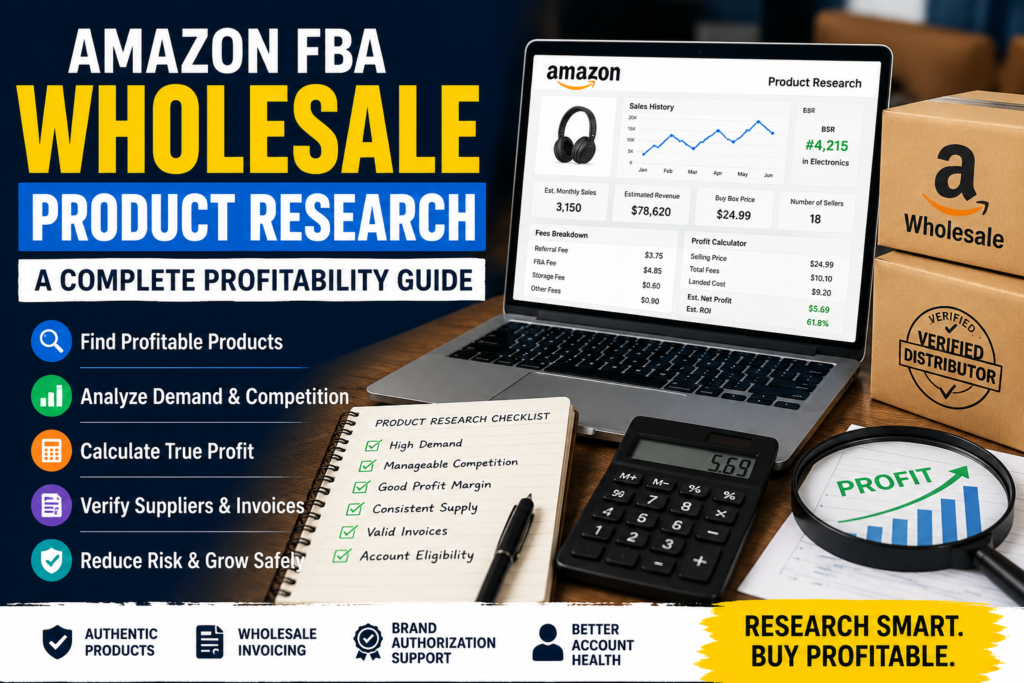
Finding a wholesale product with a low supplier price does not automatically make it a profitable Amazon FBA opportunity. A product may look attractive on a wholesale stock list but become unprofitable after Amazon fees, inbound shipping, preparation costs, storage charges, returns, price changes, and competition are considered. In other cases, a product may appear financially promising but be unsuitable because the seller is restricted from listing it or cannot verify that the physical item matches the Amazon detail page. Successful Amazon FBA wholesale product research therefore requires more than checking a sales rank or calculating a simple price difference. Sellers need to evaluate demand, competition, total costs, selling eligibility, product condition, documentation, replenishment potential, and downside risk before purchasing inventory. In our previous guide to Health & Household wholesale sourcing, we explained why profitability should be considered alongside listing accuracy, product condition, shelf life, and supplier documentation. This guide expands that process into a practical framework that can be applied across multiple wholesale categories. Quick Answer How do you research profitable wholesale products for Amazon FBA? To research a wholesale product, confirm that your account can sell the exact ASIN, review its price and sales history, study the number and quality of competing sellers, calculate the complete landed cost, estimate Amazon fees, evaluate demand, and determine how quickly the inventory may sell. A suitable product should offer a realistic profit margin, manageable competition, stable demand, reliable replenishment, accurate listing compatibility, and an acceptable level of risk. No research method can guarantee profitability because prices, fees, restrictions, demand, and competition may change. What Is Amazon FBA Wholesale Product Research? Amazon FBA wholesale product research is the process of evaluating branded products available from wholesale suppliers to determine whether they may be suitable for resale through Amazon. Unlike private-label research, wholesale sellers are usually analyzing products that already have active listings, customer reviews, sales history, established brands, and existing competition. The seller’s job is not simply to find a popular product. The goal is to determine whether that specific product can be purchased, documented, listed, replenished, and resold at a reasonable profit. A complete research process should answer five important questions: AI Snippet Answer: What Makes a Wholesale Product Profitable? A profitable wholesale product normally has sufficient demand, manageable competition, a stable selling price, reasonable Amazon fees, reliable availability, and enough margin to absorb routine expenses and price changes. The physical product must also match the Amazon listing, and the seller should be eligible to sell it. Profitability alone does not remove listing, documentation, authenticity, or account-health risks. Why Product Research Matters for Amazon FBA Sellers Wholesale sellers often purchase multiple units at one time. This means a research mistake is multiplied across the entire order. For example, buying 100 units of a product that loses only $2 per sale can create a potential $200 loss before storage, returns, or disposal costs are considered. A product that stops selling may also tie up cash that could have been used for more suitable inventory. Careful research helps sellers avoid several common problems. Protecting Working Capital Cash flow is essential in a wholesale business. Money spent on slow-moving inventory may remain unavailable for weeks or months. Product research helps sellers estimate: Reducing Pricing Risk The current Buy Box price is only a snapshot. It may increase or decrease when: A product should not depend on the highest recent price to remain profitable. Supporting Better Sourcing Records Amazon may request information about where inventory was purchased in connection with approval requests, authenticity complaints, restricted-product reviews, or account notifications. Working with a traceable wholesale supplier can help sellers maintain clearer invoices, payment records, shipping information, and purchasing history. These documents may help support a review depending on Amazon’s requirements, but they do not guarantee approval or ungating. Avoiding Unsuitable Products Some products may have: Good product research identifies these risks before inventory is purchased. Step-by-Step Amazon FBA Wholesale Product Research Guide Step 1: Start With a Legitimate Wholesale Source Begin with products offered through a verifiable business supplier rather than searching only for the cheapest online price. Review the supplier’s: You can review the background and wholesale approach of Nations Distributor before opening an account or requesting product information. A professional website alone is not enough to verify a supplier. Compare the company information shown on its website, invoices, emails, payment records, and other available business documents. Step 2: Review the Wholesale Stock List A wholesale stock list may include product names, brands, UPCs, case quantities, unit prices, available quantities, and minimum-order information. Do not immediately choose products with the largest difference between wholesale cost and Amazon price. First create a shortlist based on: New sellers should avoid analyzing hundreds of products at once. A shortlist of 10 to 20 products is easier to evaluate accurately. Step 3: Confirm Selling Eligibility Search for the exact ASIN in Seller Central before placing an order. Check whether: Requirements may vary by category, marketplace, product, brand, and seller account. Eligibility for one item does not necessarily mean you can sell every product from the same brand. Step 4: Match the Product to the Exact Listing A profitable calculation is irrelevant when the supplied product does not match the selected Amazon listing. Compare: A single unit should not be sold against a multipack listing. Similarly, two products with nearly identical packaging may have different sizes, formulas, barcodes, or quantities. Step 5: Evaluate Demand Demand tells you whether customers are purchasing the product, but no single metric provides a complete answer. Review: AI Snippet Answer: Is a Low BSR Always Better? A lower Best Sellers Rank generally suggests stronger recent sales within a category, but BSR should not be used alone. Rank can change quickly and may be influenced by temporary promotions, seasonality, stockouts, or category differences. Sellers should evaluate BSR history alongside price history, competition, estimated sales, fees, restrictions, and product availability. Step 6: Analyze the Competition A product with strong demand may still be difficult to sell