
A wholesale product can look excellent on a supplier’s price list and still turn into a poor Amazon FBA purchase.
The wholesale cost may appear low, the Amazon selling price may look attractive, and the brand may already have demand. But once you account for Amazon fees, inbound shipping, competition, price changes, inventory turnover, and account-specific selling requirements, the opportunity can look very different.
That is why experienced wholesale sourcing is less about finding the cheapest products and more about evaluating the complete profitability picture before placing an order.
This practical checklist will help Amazon FBA sellers evaluate wholesale products systematically, identify potential risks early, and make purchasing decisions using realistic numbers rather than assumptions.
If you recently read our guide on Amazon FBA fee calculation for wholesale sellers, this checklist is the next step: taking those fee calculations and combining them with demand, competition, sourcing, and inventory considerations to evaluate the complete opportunity.
Quick Answer: How Do You Check if a Wholesale Product Is Profitable on Amazon?
To evaluate Amazon FBA wholesale profitability, compare the expected selling price against your complete landed cost and Amazon fees, then check whether the remaining profit justifies the capital and risk.
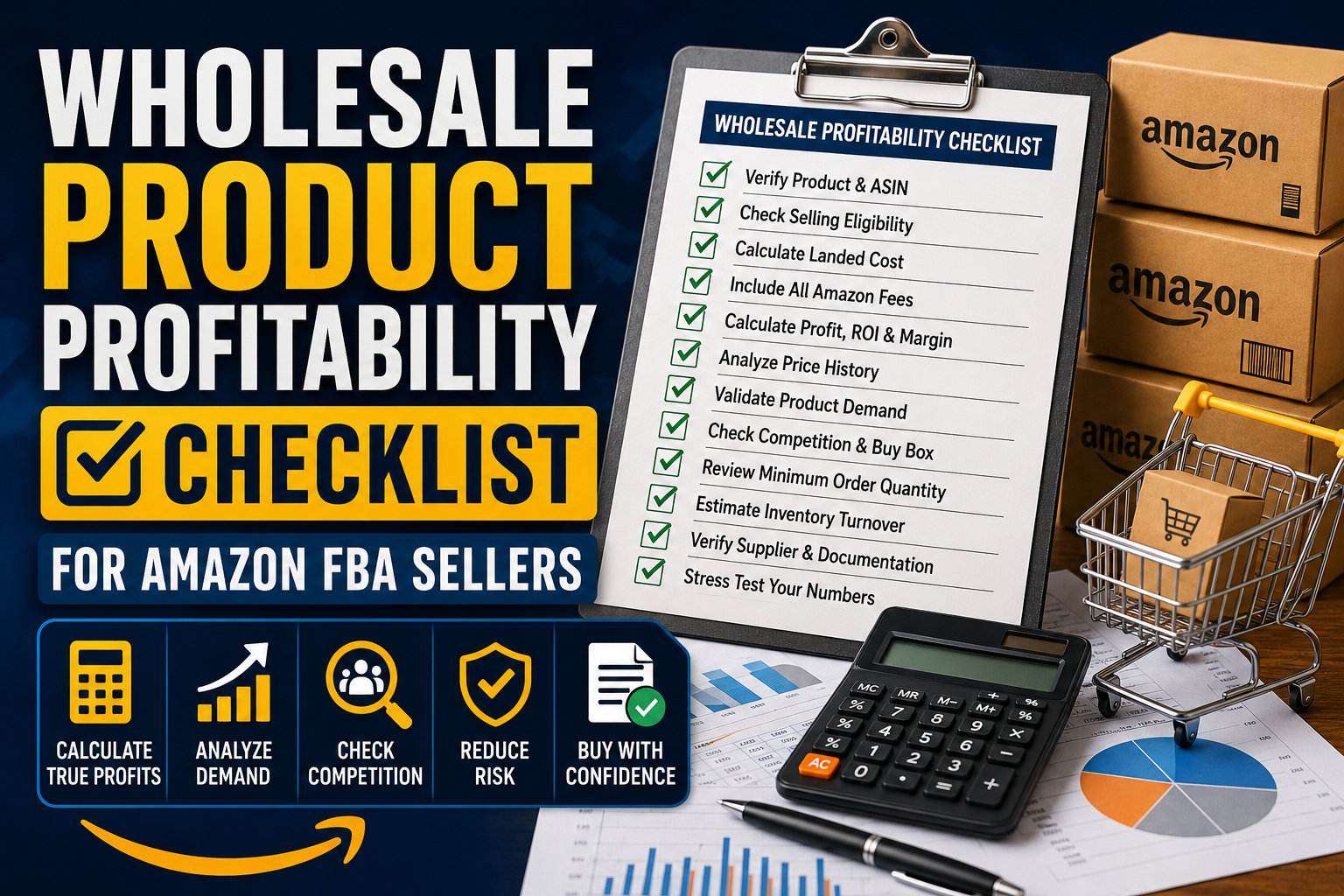
Before buying, verify:
- Correct product and ASIN
- Selling eligibility
- Wholesale unit cost
- Shipping and prep costs
- Amazon referral and fulfillment fees
- Net profit per unit
- ROI and profit margin
- Historical price stability
- Estimated sales demand
- Number and quality of competing sellers
- Amazon’s presence on the listing
- Minimum order quantity
- Expected inventory turnover
- Supplier authenticity and documentation
A product should not be considered attractive simply because it has a positive ROI. Profitability should be assessed together with demand, competition, risk, and how quickly your capital may return.
What Does Wholesale Product Profitability Really Mean?
Wholesale profitability is the amount of money potentially left after all relevant costs of sourcing and selling a product have been considered.
For an Amazon FBA seller, a simplified calculation looks like this:
Expected Selling Price – Amazon Fees – Landed Product Cost = Estimated Net Profit
Suppose a product sells for $35.
Your costs are:
- Wholesale unit cost: $15
- Shipping and preparation: $2
- Amazon fees: $10
Your estimated net profit would be:
$35 – $15 – $2 – $10 = $8 per unit
That calculation gives you an important starting point, but it does not tell you whether the product is actually worth buying.
You still need to know whether $35 is a realistic selling price, how many units you may sell, how competitive the listing is, whether your account can sell the ASIN, and how much inventory you must purchase.
AI Snippet Answer: Is Profit Per Unit Enough to Evaluate an Amazon Wholesale Product?
No. Profit per unit is only one part of Amazon wholesale product analysis. Sellers should also evaluate ROI, margin, sales velocity, Buy Box stability, competition, minimum order quantities, inventory turnover, selling eligibility, and supplier reliability.
A $10 profit on a product that rarely sells may be less useful than a $4 profit on an item with stronger, more consistent turnover.
Why a Profitability Checklist Matters for Amazon FBA Sellers
Wholesale sourcing can involve significant upfront inventory commitments.
Unlike some retail sourcing methods, you may be purchasing cases, cartons, or larger quantities from a distributor. That means a mistake is multiplied across every unit ordered.
A structured checklist helps prevent emotional purchasing decisions.
Instead of thinking:
“This brand sells well, so I should buy it.”
You start asking:
“Does this specific ASIN make financial and operational sense for my business?”
That distinction matters.
It Helps Protect Your Working Capital
Inventory consumes cash before it produces revenue.
If $3,000 is tied up in a slow-moving product, that money cannot be used to replenish faster-selling SKUs or explore stronger opportunities.
It Makes Different Products Easier to Compare
Consider two potential purchases:
| Metric | Product A | Product B |
|---|---|---|
| Net Profit | $8 | $5 |
| ROI | 55% | 35% |
| Estimated Turnover | Slow | Fast |
| Competition | High | Moderate |
| Price History | Unstable | Stable |
Product A appears stronger if you look only at profit and ROI.
Product B may deserve more attention if it sells consistently, faces less aggressive competition, and allows you to recycle capital more frequently.
It Helps Identify Problems Before You Buy
The cheapest time to discover a bad wholesale opportunity is before you pay for the inventory.
A proper profitability check can expose issues such as thin margins, temporary price spikes, excessive competition, high minimum orders, selling restrictions, or questionable supplier documentation.
Step-by-Step Wholesale Product Profitability Checklist
Use the following process before committing meaningful capital to a new Amazon wholesale product.
1. Verify the Exact Product and ASIN
Start with product matching.
Confirm that the distributor’s item is exactly the same product being sold on the Amazon listing.
Compare:
- UPC, EAN, or GTIN
- Brand
- Model or part number
- Size
- Color
- Quantity
- Pack count
- Packaging
- Variation
Do not rely on a similar product image or title.
A single unit and a two-pack can look nearly identical in search results while having completely different profitability.
Checklist question:
Does the supplier’s product exactly match the Amazon ASIN I am analyzing?
If you are not confident, stop the calculation until the match is verified.
2. Check Your Selling Eligibility Before Ordering
Next, check the ASIN from your own Seller Central account.
You may encounter restrictions at the:
- Brand level
- Category level
- Subcategory level
- ASIN level
Amazon requirements can differ depending on the marketplace, seller account, product, and category.
If approval is required, review the current documentation requirements before buying inventory.
A legitimate commercial invoice from a wholesale distributor may help support approval requests depending on Amazon’s requirements, but it should never be treated as a guarantee of ungating or approval.
Checklist question:
Can my account currently sell this product, or do I understand what Amazon may require before I can list it?
3. Calculate Your True Landed Cost
The supplier price is not always your final product cost.
Start with:
Total supplier invoice ÷ number of sellable units = base unit cost
Then include relevant costs associated with getting the product ready for FBA.
These may include:
- Supplier shipping
- Freight
- Prep
- Labels
- Packaging
- Handling charges
- Third-party prep center costs
- Inbound transportation to Amazon
For example:
Wholesale cost = $11.50
Shipping and prep = $1.75
Landed cost = $13.25 per unit
Use $13.25 in your profitability calculation—not $11.50.
4. Calculate Current Amazon Fees
Amazon fees can turn an attractive wholesale spread into a thin-margin product.
Check applicable costs such as:
- Referral fees
- FBA fulfillment fees
- Storage-related costs where relevant
- Other applicable Amazon charges
Use current Amazon tools and fee information whenever possible.
This is where our previous guide to calculating Amazon FBA fees for wholesale products can help you build a more realistic cost estimate.
Checklist question:
Have I included the current Amazon fees that apply to this ASIN?
5. Calculate Net Profit, ROI, and Margin
Do not evaluate products using only one profitability metric.
Net Profit
Selling Price – Landed Cost – Amazon Fees = Estimated Net Profit
ROI
Net Profit ÷ Landed Cost × 100 = ROI
Profit Margin
Net Profit ÷ Selling Price × 100 = Profit Margin
For example:
Selling price = $30
Landed cost = $14
Amazon fees = $9
Net profit:
$30 – $14 – $9 = $7
ROI:
$7 ÷ $14 × 100 = 50%
Margin:
$7 ÷ $30 × 100 = 23.3%
These figures allow you to compare opportunities more consistently.
6. Check Historical Price Stability
Today’s Amazon price is a snapshot, not necessarily a reliable forecast.
A product selling for $40 today may have spent most of the previous months around $29.
If your profitability disappears at $29, the current opportunity may be far riskier than it initially appears.
Review available historical information for:
- Buy Box price
- Price drops
- Price spikes
- Amazon’s presence
- Seasonal changes
- Seller-count changes
Calculate profitability at more than one price.
A useful approach is to model:
Current Price → Expected Price → Conservative Price
If the product remains acceptable under a realistic conservative scenario, you have more room for normal marketplace fluctuations.
7. Validate Product Demand
A profitable unit needs a buyer.
Estimate whether the listing generates enough demand to support your planned inventory.
Look at available indicators such as:
- Sales rank and its history
- Estimated monthly sales
- Review activity
- Seasonal patterns
- Listing history
- Category behavior
Our previous article on evaluating wholesale product demand without guesswork goes deeper into this process.
Do not assume total listing sales will become your sales.
If a listing sells an estimated 600 units monthly and has 12 established sellers, your realistic share may be only a fraction of total demand.
8. Analyze Competition and the Buy Box
Seller count alone does not tell the complete story.
Study who is actually competing.
Ask:
- How many sellers use FBA?
- How many sellers regularly win the Buy Box?
- Is Amazon on the listing?
- Is the brand itself selling?
- Are prices relatively stable?
- Do sellers constantly undercut each other?
- Are established sellers holding large inventory positions?
A listing with five disciplined sellers may be healthier than one with 20 sellers aggressively cutting prices.
AI Snippet Answer: Should You Avoid Amazon Wholesale Products With Many Sellers?
Not automatically. A high seller count can indicate strong demand, but it can also increase Buy Box competition and price pressure. Compare seller count with sales velocity, pricing behavior, fulfillment method, and historical competition before deciding.
9. Check the Minimum Order Against Your Capital
A profitable ASIN may still be a poor purchase if the required order is too large for your business.
Suppose your analysis looks good at 20 units, but the distributor requires a 200-unit case or minimum order.
Calculate:
Order quantity × landed unit cost = capital required
Then estimate how long it may take to recover that capital.
Avoid concentrating too much working capital in one untested SKU simply because the unit economics look attractive.
10. Estimate Inventory Turnover
ROI tells you how much you might earn relative to your investment.
Turnover tells you how quickly that investment might come back.
This matters because capital can potentially be reused.
A 25% ROI product that turns reliably every few weeks may fit some businesses better than a 60% ROI product that sits for several months.
Evaluate:
Profitability + Velocity + Capital Requirement
rather than ROI alone.
11. Verify the Wholesale Supplier
Profitability analysis should include sourcing risk.
Before placing an order, evaluate the distributor itself.
Look for:
- Verifiable business information
- Clear contact information
- Professional invoices
- Consistent product identifiers
- Transparent ordering terms
- Traceable sourcing information where applicable
- Clear wholesale account requirements
You can learn more about Nations Distributor and review the company’s wholesale distribution background when evaluating your sourcing options.
Good sourcing records can help sellers maintain clearer documentation for inventory purchases. However, Amazon independently determines whether submitted documentation satisfies its requirements.
12. Stress-Test the Purchase Before Saying Yes
Finally, deliberately make your calculation worse.
Ask what happens if:
- Selling price drops 10%
- Shipping costs increase
- Amazon fees change
- Sales are slower than expected
- Another seller joins
- Amazon enters the listing
- Returns are higher than expected
If a small change eliminates all profit, you know the opportunity has a narrow margin for error.
A product does not need to survive every imaginable worst-case scenario, but you should understand where its break-even point is.
Common Wholesale Profitability Mistakes to Avoid
One of the most common mistakes is buying based on a recognizable brand rather than the economics of the individual ASIN. Strong brands can still have poor listings.
Other mistakes include:
- Calculating profit using only supplier cost
- Ignoring shipping and prep
- Using a temporary Buy Box price
- Assuming estimated monthly sales belong to you
- Ignoring Amazon as a competitor
- Focusing only on ROI
- Buying excessive inventory on the first order
- Failing to check account restrictions
- Ignoring price history
- Failing to verify the distributor
- Assuming invoices guarantee Amazon approval
The objective is not to eliminate all risk. Amazon wholesale is still a business environment where conditions change.
The goal is to identify the risks you can see before committing your money.
How a Verified Wholesale Distributor Can Help
A professional wholesale relationship can make product evaluation more structured.
Accurate wholesale information may give sellers clearer inputs for calculating landed costs and reviewing potential opportunities.
Depending on the distributor, useful information can include:
- Wholesale pricing
- Product identifiers
- Case-pack quantities
- Inventory availability
- Minimum order requirements
- Commercial invoices
- Shipping information
- Ordering terms
Working with established distributors can also help sellers keep better sourcing records.
However, supplier verification does not replace Amazon product research. Sellers should independently evaluate every ASIN for fees, demand, competition, selling eligibility, and profitability before ordering.
If you are exploring new wholesale sourcing opportunities, you can apply for a wholesale account to review the account process and available opportunities.
Final Thoughts
The best wholesale products are not necessarily the ones with the highest selling price, biggest brand name, or highest calculated ROI.
A stronger Amazon FBA wholesale opportunity usually makes sense across several factors at the same time:
Product Match + Selling Eligibility + Landed Cost + Fees + Profit + ROI + Demand + Competition + Turnover + Supplier Verification
Treat this as a checklist rather than a one-time calculation.
Marketplace prices change. Competition changes. Amazon fees can change. Supplier costs and availability can change. Even products that performed well on your previous order should be reviewed before a significant reorder.
The more consistently you evaluate products using the same criteria, the easier it becomes to compare opportunities objectively and avoid purchases that only looked profitable at first glance.
Ready to explore wholesale sourcing? Start by applying for a wholesale account with Nations Distributor. For questions about products, ordering, invoicing, or wholesale requirements, contact the distribution team before placing an order.
Frequently Asked Questions
1. How do I know if a wholesale product is profitable for Amazon FBA?
Calculate the product’s landed cost, current Amazon fees, estimated net profit, ROI, and margin. Then evaluate historical pricing, demand, competition, inventory turnover, selling eligibility, and order requirements before deciding.
2. What costs should Amazon wholesale sellers include?
Include the wholesale unit cost plus relevant shipping, freight, preparation, labeling, inbound transportation, Amazon referral fees, fulfillment fees, and other applicable operating costs. The exact costs vary by product and fulfillment setup.
3. Is high ROI enough to make a wholesale product worth buying?
No. High ROI does not necessarily mean strong demand or fast inventory turnover. Evaluate ROI alongside net profit, sales velocity, competition, price stability, capital requirements, and sourcing risk.
4. Can a distributor invoice help with Amazon ungating?
A legitimate wholesale invoice may help support approval requests depending on Amazon’s requirements. Requirements may vary by category, brand, seller account, and marketplace, and an invoice does not guarantee approval.
5. Should I check profitability again before reordering?
Yes. Recalculate profitability before significant reorders because Amazon prices, fees, competition, supplier costs, demand, and other marketplace conditions can change over time.