When you start selling on Amazon FBA, one of the first big questions is simple: where should you buy inventory?
Many beginner sellers look at retail stores, online marketplaces, clearance deals, and local shops because they are easy to access. Others move toward wholesale distributors because they want a more structured sourcing process, better documentation, and repeatable product access.
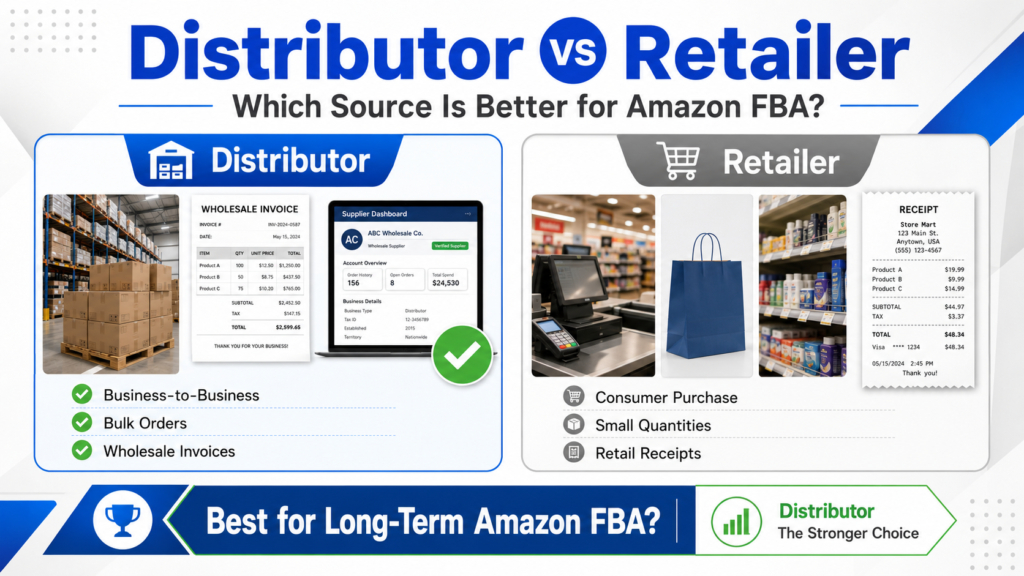
Both options can exist in an Amazon seller’s journey, but they are not the same. A retailer is built to sell products to end customers. A distributor is built to sell products in bulk to businesses. That difference matters when you are trying to protect your Amazon account health, keep better sourcing records, and source authentic products for long-term selling.
In our previous guide on how to read a wholesale price list before buying Amazon inventory, we explained why sellers should look beyond unit price. This article continues that topic by comparing distributors and retailers so you can understand which source may be better for your Amazon FBA business.
Quick Answer
For Amazon FBA sellers, a verified wholesale distributor is usually a better long-term sourcing option than a retailer because distributors may provide business-to-business invoices, bulk inventory access, product category support, and cleaner sourcing records. Retailers can be useful for product research or small tests, but retail receipts may not offer the same documentation value as wholesale invoices. Amazon requirements may vary by category, brand, marketplace, and seller account.
Distributor vs Retailer: What Is the Difference?
Before choosing a sourcing method, it is important to understand the basic difference between a distributor and a retailer.
What Is a Distributor?
A distributor is a business that purchases products from brands, manufacturers, importers, or higher-level supply chain partners and sells them to other businesses. In Amazon FBA sourcing, distributors often work with ecommerce sellers, resellers, stores, and wholesale buyers.
A distributor may offer:
- Bulk product availability
- Wholesale pricing
- Business account onboarding
- Product category access
- Commercial invoices
- Order records
- Repeat buying opportunities
- Business-to-business communication
A wholesale distributor is usually more suitable for sellers who want to build a serious, repeatable sourcing process.
What Is a Retailer?
A retailer sells products directly to final consumers. Retail stores, ecommerce shops, supermarkets, pharmacy chains, department stores, and online retail marketplaces are examples of retailers.
A retailer may offer:
- Easy product access
- Small quantity purchases
- Public pricing
- Promotions and clearance deals
- Retail receipts
- Fast checkout
- No business account requirement
Retail sourcing may be easier for beginners, but it is not always ideal for long-term Amazon FBA documentation needs.
Why This Topic Matters for Amazon FBA Sellers
Amazon sellers are not just buying products. They are building a business inside a marketplace where product authenticity, customer trust, documentation, and account health matter.
The source you choose can affect:
- Your ability to keep proper purchase records
- The quality of invoices or receipts you receive
- Product authenticity confidence
- Repeat inventory availability
- Brand or category approval preparation
- Amazon account health documentation
- Long-term business scalability
If Amazon ever asks for proof of sourcing, a random retail receipt may not provide the same level of detail as a commercial wholesale invoice. A wholesale invoice may help support approval requests, authenticity reviews, or documentation requests depending on Amazon’s requirements.
That does not mean every distributor invoice guarantees approval. It does not. Amazon makes its own decisions based on the marketplace, category, brand, seller account, and document quality. But sourcing through a verified distributor can help sellers keep better business records from the start.
This connects with our previous article on how Nations Distributor helps Amazon sellers source authentic wholesale products, where we discussed why authentic sourcing and organized documentation matter for ecommerce sellers.
Step-by-Step Guide: How to Choose Between a Distributor and Retailer
Step 1: Define Your Amazon FBA Goal
Start by asking what you are trying to achieve.
If your goal is to learn product research, understand Amazon fees, or test small quantities, retail sourcing may be easier at the beginning. You can buy a few units, study demand, and learn how the marketplace works.
If your goal is to build a long-term wholesale business, a distributor is usually a stronger option because it supports repeat buying, business documentation, and cleaner sourcing records.
Ask yourself:
- Am I testing or scaling?
- Do I need repeat inventory?
- Will I need invoices for documentation?
- Is this product restricted or gated?
- Am I trying to build supplier relationships?
- Do I want a business-to-business sourcing process?
Your answer will help you decide which source makes more sense.
Step 2: Check Product Eligibility Before Buying
Whether you buy from a distributor or retailer, always check your Amazon eligibility before purchasing inventory.
Some products may be restricted by brand, category, condition, marketplace, or account history. A product can look profitable, but if your account is not approved to sell it, the opportunity may not be useful.
Before placing an order, check:
- Brand restrictions
- Category approval requirements
- Product condition rules
- ASIN eligibility
- Hazmat or safety requirements
- Marketplace-specific rules
- Documentation requirements
A distributor may provide invoices that can help support approval requests depending on Amazon’s requirements, but sellers should still verify eligibility before buying.
Step 3: Compare Documentation Quality
This is one of the biggest differences between distributors and retailers.
A retailer usually provides a receipt. A receipt may show the store name, date, item, quantity, and payment amount. That can be useful for basic purchase tracking, but it may not always show enough business details for Amazon documentation needs.
A distributor usually provides a commercial invoice. A stronger wholesale invoice may include:
- Supplier business name
- Supplier address and contact details
- Buyer business name
- Buyer billing or shipping address
- Invoice number
- Invoice date
- Product descriptions
- Quantities
- Pricing
- Order total
- Business-to-business transaction details
For Amazon sellers, invoice quality matters because clean records can help sellers stay better prepared if Amazon requests documents.
Step 4: Evaluate Product Authenticity Risk
Product authenticity should never be ignored. Amazon customers expect genuine products, and sellers need to be confident about where their inventory came from.
Retailers can sell authentic products, but retail sourcing can become difficult if you need a clear supply chain trail. If you buy from multiple stores, clearance sections, third-party retail marketplaces, or unknown shops, recordkeeping can become messy.
A verified wholesale distributor may help create a more organized sourcing process because sellers can purchase from a business supplier and keep invoices under one account.
Before buying from any source, ask:
- Are the products new and sealed?
- Are expiration dates available where needed?
- Are products damaged, repackaged, or mixed condition?
- Can the supplier explain the sourcing process?
- Will the invoice or receipt match your business records?
- Is the price realistic compared with the market?
Low price alone should not be the reason to buy. Authenticity and documentation matter just as much.
Step 5: Review Repeat Inventory Availability
Retail sourcing is often unpredictable. A product may be available today and gone tomorrow. Clearance deals, seasonal discounts, and retail promotions are not always repeatable.
Wholesale distributors are usually better for repeat sourcing because sellers may be able to access product lists, category options, and recurring inventory opportunities.
For Amazon FBA, repeatability matters because it allows sellers to:
- Plan reorder cycles
- Track product performance
- Build supplier relationships
- Improve listing and inventory decisions
- Reduce time spent hunting random deals
- Create a more stable sourcing system
If you want to move from one-time deals to structured wholesale buying, working with a distributor can be more practical.
Step 6: Calculate the Real Landed Cost
Some sellers choose retailers because they see a discounted product and assume it is profitable. Others choose distributors because they expect wholesale pricing to automatically create profit. Both assumptions can be risky.
Always calculate your real landed cost.
Include:
- Product cost
- Shipping cost
- Prep or labeling cost
- Amazon referral fee
- FBA fulfillment fee
- Storage fee
- Return risk
- Packaging cost
- Taxes or other business costs
- Your desired profit margin
A distributor may offer better bulk pricing, but you still need to analyze fees and competition before ordering. A retailer may offer a temporary discount, but that deal may not be scalable.
Step 7: Think About Account Health
Amazon account health is connected to the quality of your sourcing decisions. Poor sourcing can create problems such as authenticity complaints, invoice requests, restricted product issues, or inventory that cannot be sold.
A distributor can help sellers keep better sourcing records, but sellers must still follow Amazon’s rules and choose products carefully.
A good sourcing habit includes:
- Keeping invoices organized
- Matching business details correctly
- Avoiding suspicious suppliers
- Checking product restrictions
- Saving communication records
- Reviewing product condition
- Avoiding risky brands without proper research
A strong supplier relationship can support your business, but it cannot replace seller responsibility.
Common Mistakes to Avoid
Mistake 1: Thinking Retail Receipts Are the Same as Wholesale Invoices
Retail receipts and wholesale invoices are not the same. A receipt is usually proof of a consumer purchase. A wholesale invoice is usually a business-to-business purchase record. For Amazon sellers, this difference can matter during documentation reviews.
Mistake 2: Buying Products Before Checking Restrictions
Never buy inventory first and check restrictions later. Always confirm whether your account can sell the product before placing an order.
Mistake 3: Choosing Only the Cheapest Source
The cheapest source is not always the safest source. Very low pricing can sometimes come with poor documentation, unclear product origin, damaged inventory, or limited repeatability.
Mistake 4: Ignoring Supplier Verification
If you are buying from a distributor, verify the business. Check the website, contact details, application process, business information, invoice structure, and communication quality.
Mistake 5: Expecting Guaranteed Amazon Approval
No supplier, distributor, retailer, or service provider can guarantee Amazon approval, ungating, or brand authorization. Documents may help support requests, but Amazon makes the final decision.
Mistake 6: Not Saving Records
Keep all purchase documents, invoices, receipts, shipping records, and communication. Organized records can help sellers respond more professionally if Amazon asks for proof later.
How a Verified Wholesale Distributor Can Help
A verified wholesale distributor can help Amazon sellers build a more structured sourcing process. Instead of chasing random retail deals, sellers can work through a business account, review product categories, request available inventory, and keep better purchase records.
Nations Distributor focuses on wholesale sourcing for Amazon FBA and ecommerce sellers. Sellers can visit the Nations Distributor website to explore the company’s wholesale focus, product categories, and sourcing information.
A verified distributor may help with:
- Business-to-business wholesale access
- Product category options
- Commercial wholesale invoices
- More organized purchase records
- Supplier communication
- Repeat sourcing opportunities
- Documentation that may help support approval requests
- Better sourcing habits for Amazon sellers
If you are new to wholesale, you can learn more about the company on the About Us page or contact Nations Distributor before placing an order.
For sellers ready to move beyond retail sourcing, the next step is to apply for a wholesale account and request more information about available product options, order requirements, and documentation support.
Final Thoughts
So, distributor vs retailer: which source is better for Amazon FBA?
For beginners, retailers can be useful for learning, testing, and understanding product research. Retail sourcing is easy to start, but it may not provide the best long-term documentation, repeatability, or business structure.
For serious Amazon FBA sellers, a verified wholesale distributor is usually the better long-term option. Distributors can offer business-to-business sourcing, wholesale invoices, category access, and more organized records that may help sellers manage sourcing documentation more professionally.
The best choice depends on your stage, budget, product eligibility, and business goals. But if you want to build a more stable Amazon FBA wholesale model, working with a distributor is often the more practical direction.
Ready to explore wholesale sourcing? Visit Nations Distributor, review available product categories, apply for a wholesale account, or contact the distributor to ask questions before getting started.
FAQs
1. Is a distributor better than a retailer for Amazon FBA?
A distributor is usually better for long-term Amazon FBA sourcing because it may provide wholesale invoices, bulk inventory access, repeat buying opportunities, and cleaner business records. Retailers may be useful for testing, but they are not always ideal for documentation.
2. Can I use retail receipts for Amazon approval requests?
Retail receipts may not provide the same documentation value as wholesale invoices. Amazon requirements may vary, but sellers often prefer commercial invoices because they show clearer business-to-business sourcing details.
3. Does a wholesale distributor guarantee Amazon ungating?
No. A wholesale distributor cannot guarantee Amazon ungating or approval. Wholesale invoices may help support approval requests depending on Amazon’s category, brand, marketplace, and seller account requirements.
4. Why do Amazon sellers prefer wholesale distributors?
Amazon sellers often prefer wholesale distributors because they can offer product category access, bulk purchasing, commercial invoices, supplier communication, and repeat sourcing opportunities. This can help sellers build a more organized sourcing process.
5. What should I check before buying from a distributor?
Before buying from a distributor, check product eligibility, brand restrictions, invoice details, supplier credibility, product condition, MOQ, shipping cost, FBA fees, and whether the product fits your Amazon business model.