
Running out of inventory is frustrating at any time, but it can be especially damaging during a high-demand period. You may have spent weeks improving a listing, earning customer trust and building consistent sales, only to watch your available inventory reach zero when demand is strongest.
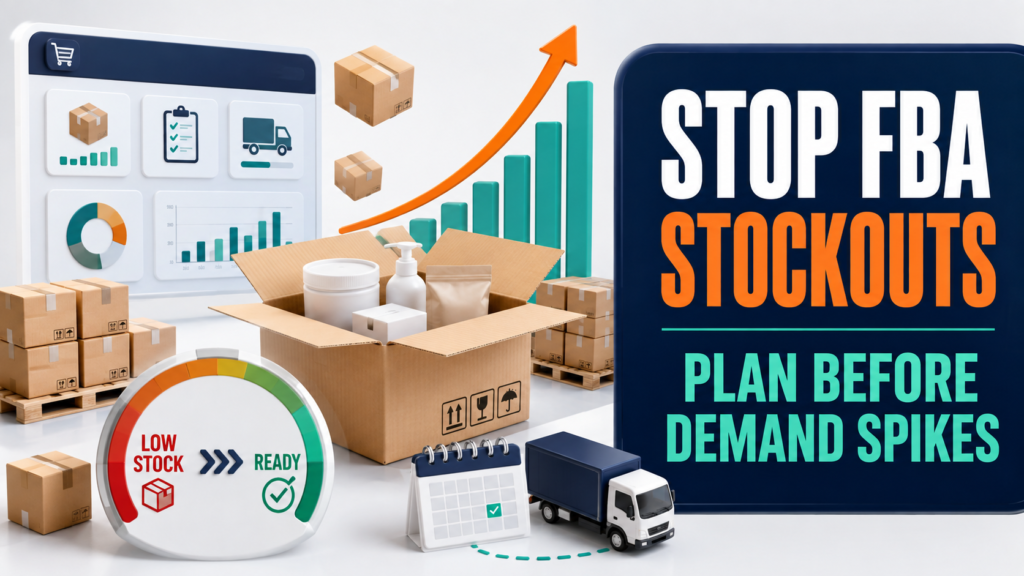
For Amazon FBA wholesale sellers, preventing stockouts is not simply about ordering more units. You must understand how quickly your inventory sells, how long replenishment takes and how much buffer stock your business can realistically afford.
Ordering too late can leave your listing unavailable. Ordering too much can lock up cash, increase storage costs and leave you holding slow-moving inventory after demand falls.
The objective is to build a repeatable inventory system that balances availability, cash flow and risk.
Quick Answer: How Can Amazon Sellers Prevent Stockouts?
Amazon FBA sellers can reduce stockout risk by forecasting demand, tracking sales velocity, calculating reorder points, maintaining appropriate safety stock and confirming supplier lead times before demand increases.
A practical stockout-prevention plan should include:
- Reviewing historical sales data
- Identifying seasonal demand changes
- Calculating average daily sales
- Setting product-specific reorder points
- Adding safety stock for unexpected demand
- Confirming supplier and shipping lead times
- Monitoring Amazon receiving delays
- Reordering before inventory reaches a critical level
- Keeping accurate wholesale sourcing records
- Creating backup plans for priority products
No method can predict demand perfectly. However, consistent inventory monitoring and reliable wholesale sourcing can help sellers make better purchasing decisions.
What Is an Amazon FBA Stockout?
An Amazon FBA stockout occurs when no sellable inventory remains available for customers to purchase. This may happen because the seller did not reorder early enough, demand increased unexpectedly or incoming inventory was delayed.
A product can also become temporarily unavailable when units are still being shipped to Amazon or are waiting to be processed at a fulfillment center. Inventory that is in transit or being transferred may not be immediately available for sale.
Common causes of Amazon FBA stockouts include:
- Unexpected increases in sales
- Inaccurate demand forecasts
- Late purchase orders
- Supplier processing delays
- Shipping and freight delays
- Amazon fulfillment center receiving delays
- Incorrect inventory data
- Insufficient safety stock
- Limited cash available for reordering
- Depending on a single supplier or shipping route
The reason is not always poor sales planning. Even an experienced seller can face unexpected demand or logistical delays. The goal is to identify the factors you can control and prepare for the ones you cannot.
Why Stockout Prevention Matters for Amazon FBA Sellers
A stockout does more than pause sales. It can interrupt the momentum of a product and affect several parts of your wholesale business.
You Lose Potential Sales
When your product is unavailable, customers may purchase from another seller or choose a competing product. During a high-demand period, every day without inventory may represent missed revenue.
Advertising May Lose Momentum
If you run Amazon PPC campaigns, a stockout can interrupt the flow of traffic and conversions. Advertising cannot generate sales when the offer is unavailable, and you may need time to rebuild campaign performance after restocking.
Customers May Move to Competitors
Many customers need a product immediately. If your offer is unavailable, they may select another seller and continue purchasing from that competitor in the future.
Your Cash-Flow Plan May Be Disrupted
A product that regularly generates sales can support the purchase of other inventory. When it goes out of stock, the missing revenue may make future purchase orders more difficult to fund.
Restocking May Become More Expensive
Waiting until inventory is nearly depleted may force you to use faster shipping, place a smaller rush order or accept less favorable purchasing terms. Advance planning gives you more time to compare practical options.
If you have already read the guide to Amazon FBA inventory planning for wholesale sellers, the next step is to turn those inventory principles into a clear stockout-prevention process.
How to Prevent Amazon FBA Stockouts: A Practical Guide
1. Calculate Your Average Daily Sales
Start by determining how many units of a product you sell on an average day.
Use this basic formula:
Average daily sales = Units sold during a period ÷ Number of days
For example, if you sold 300 units during 30 days, your average sales velocity was 10 units per day.
Do not rely on a single short period. Compare multiple time ranges, such as:
- Previous seven days
- Previous 30 days
- Previous 60 or 90 days
- The same period from the previous year, when available
- Previous promotional or seasonal periods
Recent data shows current momentum, while longer periods provide context. A sudden seven-day increase may be the beginning of a trend, or it may be a temporary spike.
2. Look for Seasonal and Event-Based Demand
Average sales alone may not prepare you for high-demand periods. Consider whether upcoming events could change purchasing behavior.
Demand may increase because of:
- Holidays
- Seasonal weather changes
- Back-to-school shopping
- Promotional campaigns
- Amazon sales events
- Product trends
- Competitor stockouts
- Changes in price or advertising
- Increased listing visibility
Review how the product performed during similar periods in the past. New sellers without historical data should use smaller test orders, monitor sales frequently and avoid assuming that a temporary spike will continue indefinitely.
3. Confirm the Complete Replenishment Lead Time
Lead time is the total time between deciding to reorder and having sellable inventory available on Amazon.
It may include:
- Internal purchasing approval
- Supplier order processing
- Product preparation
- Domestic or international shipping
- Prep-center handling
- Delivery to Amazon
- Fulfillment center receiving
- Inventory transfer between fulfillment centers
A common mistake is counting only the supplier’s shipping time. A supplier may dispatch an order quickly, but Amazon receiving and inventory distribution can still add time before units become available.
Ask your supplier practical questions before high-demand periods:
- Is the requested quantity currently available?
- How long will order processing take?
- Could holiday closures affect dispatch?
- Is there a minimum order quantity?
- Can the supplier provide case-pack and shipment details?
- Are invoices and product records available?
- Are any product limits expected during the season?
Use realistic lead times rather than the fastest possible estimate.
4. Set a Reorder Point for Every Important SKU
A reorder point is the inventory level at which you should place your next order.
A useful formula is:
Reorder point = Average daily sales × Total lead time + Safety stock
Suppose a product sells eight units per day, total replenishment takes 20 days and you want 40 units of safety stock.
Your calculation would be:
8 × 20 + 40 = 200 units
In this example, the seller should consider reordering when available inventory approaches 200 units.
Each SKU needs its own calculation. A fast-selling grocery product and a slower household product should not share the same reorder rule.
5. Maintain Appropriate Safety Stock
Safety stock is the additional inventory held to cover unexpected demand or replenishment delays.
It may help when:
- Daily sales increase unexpectedly
- A supplier takes longer to process an order
- A shipment is delayed
- Amazon receiving takes longer than expected
- Some units become damaged or unsellable
- A competitor runs out of stock and demand shifts
Safety stock should be based on risk rather than guesswork. Products with stable demand and short lead times may require a smaller buffer. Products with variable demand, longer lead times or limited supplier availability may require more protection.
However, excessive safety stock can lock up working capital and increase storage exposure. Review your buffer regularly instead of treating it as a fixed number.
6. Monitor Weeks of Cover
Weeks of cover estimates how long your current inventory will last at the present sales rate.
A simple formula is:
Weeks of cover = Available inventory ÷ Average weekly sales
If you have 400 units available and sell 100 units per week, you have approximately four weeks of cover.
This metric gives you a quick way to identify which products require attention. It is particularly helpful when managing several wholesale SKUs with different sales velocities.
Review weeks of cover more frequently as a high-demand period approaches.
7. Separate Available, Inbound and Reserved Inventory
Your inventory dashboard may show units in several statuses. Do not treat all units as immediately sellable.
Track these quantities separately:
- Available inventory
- Inbound inventory
- Reserved units
- Units being transferred
- Unsellable inventory
- Inventory at a prep center
- Confirmed supplier stock
- Ordered but not yet shipped units
A purchase order is not the same as available inventory. Similarly, units delivered to Amazon may still need to be received and processed.
Your planning sheet should show where each group of units is located and when it is expected to become sellable.
8. Place Reorders in Stages When Appropriate
Large single orders can increase inventory risk, while very small orders may create frequent shipping expenses and repeated stockout pressure.
Staggered reordering can provide a more balanced approach. Instead of placing all planned inventory into one shipment, you may divide purchases or deliveries into stages when supplier terms and logistics make that practical.
Potential benefits include:
- Better cash-flow control
- More opportunities to adjust forecasts
- Reduced exposure to sudden demand decline
- A steady flow of inbound inventory
- Lower dependence on one shipment arriving on time
This approach is not suitable for every product. Minimum order quantities, shipping rates and supplier availability must be considered.
New sellers should also review how much inventory they can realistically manage. The guide on how much wholesale inventory a new Amazon seller should buy provides additional context for balancing availability with purchasing risk.
9. Prioritize Your Most Important Products
Not every SKU deserves the same amount of cash or inventory attention.
Classify products according to factors such as:
- Sales velocity
- Contribution to profit
- Demand consistency
- Replenishment difficulty
- Supplier reliability
- Seasonal importance
- Stockout risk
Your highest-priority products should receive more frequent monitoring and earlier reorder reviews. Slow or unpredictable products may need smaller orders and tighter purchasing controls.
This prevents low-priority inventory from consuming cash that could be used to protect your strongest products.
10. Review Product Profitability Before Reordering
Avoid placing a large reorder simply because a product sells quickly. High sales volume does not automatically mean strong profitability.
Before increasing inventory, review:
- Wholesale product cost
- Amazon fees
- Inbound shipping
- Prep and labeling costs
- Advertising expenses
- Expected selling price
- Return exposure
- Storage considerations
- Realistic profit per unit
Use the wholesale product profitability checklist for Amazon FBA sellers before committing additional cash to a high-volume reorder.
A product should make financial sense as well as remain available.
11. Build a Supplier Communication Routine
Do not contact your supplier only when you urgently need stock. Regular communication can help you understand product availability, expected processing times and upcoming supply limitations.
Before a busy period, ask whether:
- Lead times are likely to change
- Certain brands or SKUs may face limited availability
- Order cut-off dates apply
- Case-pack quantities have changed
- Prices or minimum order requirements are changing
- Relevant wholesale documentation will be provided
Clear communication does not remove every risk, but it can help you make purchasing decisions using current information.
12. Create a Backup Plan
A useful backup plan identifies what you will do if normal replenishment is delayed.
Depending on your business and sourcing arrangements, this might include:
- Ordering earlier for critical SKUs
- Keeping additional safety stock
- Using more than one approved shipping method
- Holding part of the inventory outside FBA
- Adjusting advertising before inventory runs out
- Temporarily reducing promotional activity
- Prioritizing products with more reliable availability
- Working with an additional verified wholesale source
Any alternative supplier should still be properly evaluated. Do not sacrifice product authenticity, documentation or account safety simply to obtain inventory quickly.
Common Stockout-Prevention Mistakes
Reordering Based on Instinct
Inventory decisions based only on intuition may overlook changes in sales velocity and lead time. Use current product data and written calculations.
Waiting Until Inventory Is Almost Gone
Reordering at the last moment leaves little room for supplier, shipping or Amazon receiving delays.
Assuming Inbound Inventory Will Arrive on Time
Estimated arrival dates are not guarantees. Keep monitoring each shipment until inventory becomes available for sale.
Using the Same Safety Stock for Every SKU
Products have different demand patterns and supply risks. Calculate an appropriate buffer for each priority item.
Ignoring Cash Flow
Buying too much inventory may prevent you from restocking other profitable products. Stockout prevention must be balanced with available working capital.
Depending on Unverified Suppliers
Urgent sourcing can lead sellers to accept incomplete documentation or uncertain product origins. This may create product authenticity and account-health concerns.
Overreacting to a Short Sales Spike
A few strong sales days do not always indicate lasting demand. Compare short-term changes with longer sales trends before increasing order quantities significantly.
How a Verified Wholesale Distributor Can Help
A reliable wholesale distributor can make inventory planning more structured by providing clear product information, order requirements and legitimate purchasing documentation.
Working with a verified distributor may help sellers:
- Source authentic wholesale products
- Maintain clearer purchase records
- Receive commercial invoices for completed orders
- Understand case quantities and order requirements
- Plan purchases around realistic availability
- Build a repeatable wholesale sourcing process
- Prepare supporting records when Amazon requests documentation
Invoices or supplier documentation do not guarantee Amazon approval, ungating or acceptance. Requirements may vary by product, category, marketplace and seller account. However, accurate records from a legitimate wholesale source can help sellers keep better sourcing documentation and may help support approval requests depending on Amazon’s requirements.
You can learn more about the company’s wholesale approach on the About Nations Distributor page.
Sellers interested in reviewing available wholesale opportunities can visit Nations Distributor and explore the current product categories.
Final Thoughts
Preventing Amazon FBA stockouts during high-demand periods requires more than placing a larger purchase order. You need to understand sales velocity, total replenishment time, reorder points, safety stock and the amount of working capital available.
Start with a simple system:
- Track average daily sales
- Calculate a reorder point
- Add an appropriate safety-stock buffer
- Monitor available and inbound inventory separately
- Confirm supplier lead times
- Review profitability before every major reorder
- Update your plan as demand changes
No inventory forecast will be perfect. The purpose of planning is to reduce avoidable surprises and give your business enough time to respond when conditions change.
If you are looking for authentic wholesale products and a more organized sourcing process, apply for a wholesale account with Nations Distributor. You can also contact the distributor to discuss product availability, ordering information and sourcing documentation.
Frequently Asked Questions
1. What is the best way to prevent Amazon FBA stockouts?
The best approach is to track sales velocity, calculate product-specific reorder points, maintain appropriate safety stock and reorder using realistic supplier and Amazon receiving lead times.
2. How do I calculate an Amazon FBA reorder point?
Multiply average daily sales by the total replenishment lead time, then add safety stock:
Reorder point = Average daily sales × Lead time + Safety stock
Review the calculation whenever demand or lead time changes.
3. How much safety stock should an Amazon seller keep?
The appropriate amount depends on demand variability, replenishment time, supplier reliability and available cash. Fast-moving or difficult-to-replenish products may need a larger buffer than stable products with short lead times.
4. Can a wholesale distributor prevent every stockout?
No supplier can prevent every stockout. However, clear communication, realistic availability information and dependable order processing can help sellers plan replenishment more effectively.
5. Should I place a large order before a high-demand period?
Only after reviewing demand history, current sales velocity, profitability, lead time and available cash. A large order may reduce stockout risk but can also increase storage and overstock exposure if demand falls.