Amazon FBA Wholesale Distributors

How National Powersports Distributors Can Boost Your Dealership’s Profits

Running a successful powersports dealership is about more than just a passion for bikes, ATVs, and UTVs; it’s about smart business strategies. In a competitive market, your choice of distribution partner can make the difference between simply surviving and truly thriving. If you’re looking for a reliable way to increase your bottom line, partnering with a dedicated wholesale supplier like National Powersports Distributors is one of the most impactful decisions you can make. Here’s how aligning with Nations Distributor can directly boost your dealership’s profitability. 1. Access to a Vast and Diverse Inventory Customers walk into your dealership looking for specific models, parts, and accessories. If you don’t have what they need, they will quickly find it elsewhere, often turning to online marketplaces like Amazon. This results in a lost sale and a disappointed customer who may not return. National Powersports Distributors acts as your one-stop wholesale supplier, providing access to an extensive inventory from top brands. This means you can stock a wider variety of products—from the latest OEM parts to high-demand aftermarket accessories—ensuring you never have to turn a customer away. By becoming their go-to source, you increase sales and build customer loyalty, preventing them from searching on Amazon for their needs. 2. Competitive Pricing and Better Profit Margins Buying in bulk directly from a major wholesale supplier unlocks significantly better pricing than sourcing from smaller, fragmented distributors. Nations Distributor leverages its large-scale operations to secure the best possible prices from manufacturers, savings that are then passed on to you. This competitive cost price allows you to maintain healthy profit margins on every sale while still offering prices that are attractive to your customers. Even if you choose to price competitively against online giants, your lower acquisition cost from your wholesale supplier means you retain more profit per unit sold compared to dealers without this advantage. 3. Reducing Overhead and Storage Costs Inventory management is a constant balancing act. Too much stock ties up crucial capital and incurs high storage costs. Insufficient stock leads to stockouts and lost sales. National Powersports Distributors helps you optimize this balance. With reliable and fast shipping, you can implement a just-in-time inventory approach. This allows you to place larger, less frequent orders with your wholesale supplier, reducing the amount of capital sitting on your shelves and minimizing warehouse overhead. Efficient inventory turns are a direct driver of profitability, and Nations Distributor provides the supply chain reliability to make it happen. 4. Faster Shipping and Reduced Downtime In the powersports world, downtime is a profit killer. A customer waiting for a critical repair part is a frustrated customer. Slow shipping from your wholesale supplier can delay jobs, stall revenue, and harm your reputation. National Powersports Distributors prioritizes fast and reliable order fulfillment. By ensuring that the parts and accessories you need arrive quickly, you can complete repairs and installations faster. This increases your service department’s throughput, leading to higher revenue and happier customers who appreciate the speedy service. This reliability is something individual sellers on Amazon often cannot guarantee, giving you a significant competitive edge. 5. Expert Support and Knowledge Unlike the anonymous nature of buying from Amazon, partnering with Nations Distributor gives you access to a team of industry experts. This support is invaluable. Their knowledge of products, market trends, and technical specifications can help you make smarter purchasing decisions. You can get advice on which items are selling best in your region, which accessories have the highest markup, and how to bundle products for promotions. This expert guidance helps you stock smarter, not just harder, maximizing the return on every square foot of your showroom. A knowledgeable wholesale supplier is a business partner, not just a vendor. 6. Streamlined Operations and Efficiency Managing multiple vendors is time-consuming and inefficient. Processing orders, tracking shipments, and managing relationships with dozens of smaller suppliers takes your focus away from selling and serving customers. Consolidating your purchases with a primary wholesale supplier like National Powersports Distributors simplifies your entire operation. You have one main point of contact, one streamlined ordering process, and consolidated shipments. This efficiency saves your team countless administrative hours, allowing them to focus on revenue-generating activities like sales and customer service. Conclusion: Partner for Profit While online platforms like Amazon may seem convenient for one-off purchases, they lack the specialized focus, pricing advantages, and partnership approach that a dealership needs to grow sustainably. National Powersports Distributors is more than just a wholesale supplier; we are a strategic partner invested in your success. By providing competitive pricing, vast inventory, fast shipping, and expert support, Nations Distributor gives you the tools to increase sales, reduce costs, and ultimately, significantly boost your dealership’s profits. Q1: What is National Powersports Distributors? A: National Powersports Distributors is a leading wholesale supplier in the powersports industry. We provide dealerships with OEM parts, aftermarket accessories, and gear to help them serve their customers better and grow their profits. Q2: Why shouldn’t I just order parts from Amazon? A: While platforms like Amazon can be convenient for individual consumers, they lack the specialized focus, volume pricing, and dedicated support that a dealership requires. As your dedicated wholesale supplier, we offer competitive bulk pricing, industry expertise, faster shipping on large orders, and a partnership focused on your business’s growth—things Amazon cannot provide. Q3: Do I have to order in large quantities? A: As a wholesale supplier, we primarily focus on bulk orders to provide you with the best possible pricing. However, we understand the needs of growing dealerships. Contact us directly to discuss your specific requirements and we can find a solution that works for you. Q4: How fast is your shipping? A: We prioritize fast and reliable order fulfillment to minimize downtime for your dealership. Exact shipping times depend on your location and the size of the order, but our goal is to get you the products you need as quickly as possible. Q5: Do you offer any dealership support beyond selling products? A: Absolutely. We see ourselves as a strategic partner, not just a vendor. We provide support with inventory management advice, insights on top-selling products, and sales strategies to help you maximize your profitability.
Read More »
Amazon FBA Inventory

Amazon FBA Inventory Planning for Wholesale Sellers: Complete Guide

Running an Amazon wholesale business is not simply about finding a profitable product and sending as many units as possible to FBA. One of the biggest ongoing challenges is deciding how much inventory to purchase, when to reorder, and how to keep enough stock available without tying up too much cash. Order too little and you may run out of stock while a product is selling well. Order too much and capital can become trapped in slow-moving inventory while storage and other inventory-related costs continue to accumulate. That is why Amazon FBA inventory planning should be treated as a core part of wholesale sourcing rather than something you think about after placing an order. A practical inventory plan combines sales demand, supplier lead times, existing stock, inbound units, seasonality, cash flow, and Amazon-specific considerations. When these factors are reviewed together, wholesale sellers can make purchasing decisions based on evidence rather than guesswork. If you are still deciding which wholesale products deserve your capital, start with our guide on how to evaluate wholesale product demand without guesswork before building your inventory plan. How Should Amazon FBA Sellers Plan Inventory? Amazon FBA wholesale sellers should plan inventory by estimating expected sales, calculating days of supply, monitoring supplier lead times, setting reorder points, and maintaining appropriate safety stock. A basic process looks like this: The objective is not simply to keep the maximum possible inventory in FBA. It is to maintain enough appropriate inventory at the appropriate time while protecting working capital. What Is Amazon FBA Inventory Planning? Amazon FBA inventory planning is the process of estimating how much inventory a seller will need and deciding when additional wholesale stock should be purchased and replenished. For a wholesale seller, inventory usually moves through several stages: Distributor → Seller or Prep Location → Amazon FBA → Customer Each stage takes time. This means an Amazon seller cannot wait until the final few units are left before placing another wholesale order. By the time the distributor processes the order, inventory is prepared, products are shipped, and Amazon receives the shipment, the existing stock could already be depleted. Effective inventory planning attempts to keep these timelines synchronized. The Main Components of an FBA Inventory Plan A useful inventory plan should consider: These factors are connected. Looking at only one number, such as last month’s sales, rarely provides enough information for a good purchasing decision. Why Inventory Planning Matters for Amazon FBA Wholesale Sellers Wholesale sellers often purchase products in larger quantities than retail arbitrage or online arbitrage sellers. As a result, an inventory mistake can affect a larger portion of the seller’s working capital. Consider a simple example. Suppose a product sells approximately 10 units per day and you currently have 300 sellable units. At the current sales rate: 300 units ÷ 10 units per day = approximately 30 days of supply Thirty days may initially sound comfortable. However, imagine your complete replenishment cycle—from placing a distributor order to having sellable units available at Amazon—takes around 20 days. You effectively have only about 10 days of additional inventory coverage before the replenishment timeline becomes tight. This is why inventory should be measured in days of supply, not only in total units. Inventory Planning Helps Protect Cash Flow Every unit sitting in inventory represents money that cannot immediately be used elsewhere. Overordering one SKU may prevent you from purchasing another attractive product or replenishing a faster-moving ASIN. Good inventory planning helps sellers balance two competing objectives: Availability: Keep enough inventory to support expected customer demand. Capital efficiency: Avoid purchasing significantly more inventory than the business can reasonably sell within the planned period. Before committing capital to a reorder, it is also useful to run the product through a profitability review. Our wholesale product profitability checklist for Amazon FBA sellers covers the major factors sellers should examine before increasing inventory exposure. Step-by-Step Amazon FBA Inventory Planning Guide Step 1: Calculate Your Current Sales Velocity Start by determining how quickly the product is actually selling. A simple calculation is: Average Daily Sales = Units Sold ÷ Number of Days For example, if you sold 240 units during the previous 30 days: 240 ÷ 30 = 8 units per day Do not automatically assume that eight units per day will continue indefinitely. Compare multiple periods when sufficient data is available, such as: This helps you identify whether sales are increasing, decreasing, stable, or being temporarily affected by a promotion or seasonal event. Step 2: Calculate Days of Supply Next, determine approximately how long your available inventory will last. Use: Days of Supply = Available Inventory ÷ Average Daily Sales If you have 400 units available and sell eight units per day: 400 ÷ 8 = 50 days of supply This number is much more actionable than simply knowing you have 400 units. Step 3: Determine Your True Replenishment Lead Time One common mistake is counting only the distributor’s shipping time. Your actual lead time may include: If the supplier ships in five days but the entire process takes 18 days, your inventory planning should be based closer to the full 18-day cycle, not five days. Keep records of actual lead times for each supplier. Real historical performance is generally more useful for planning than assuming every future order will follow an ideal timeline. Step 4: Establish a Reorder Point Your reorder point tells you when it is time to begin replenishment. A simple model is: Reorder Point = Expected Demand During Lead Time + Safety Stock Assume: Expected lead-time demand: 8 × 20 = 160 units Reorder point: 160 + 80 = 240 units Under this simplified example, you would consider reordering when inventory approaches approximately 240 units. The appropriate safety stock will vary by product, supplier reliability, sales volatility, seasonality, and the seller’s risk tolerance. Step 5: Account for Inbound Inventory Do not treat inbound units as if they do not exist, but do not treat them exactly like immediately sellable FBA inventory either. For example: On paper,

Read More »

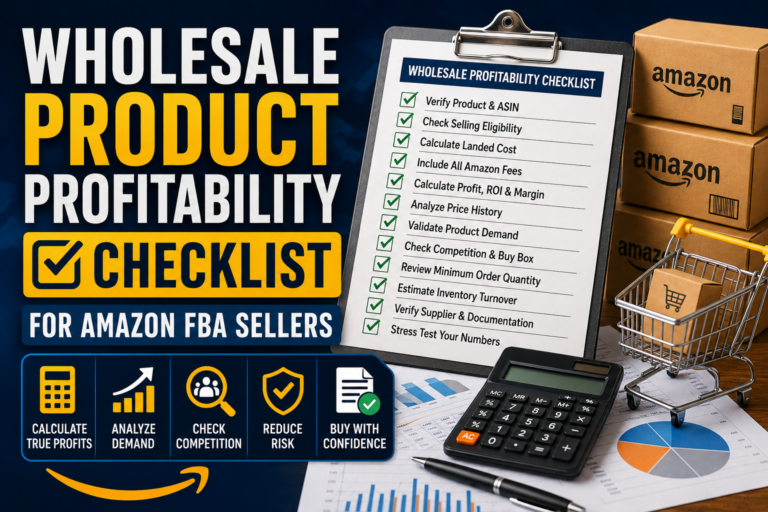
Wholesale Product Profitability Checklist for Amazon FBA Sellers

A wholesale product can look excellent on a supplier’s price list and still turn into a poor Amazon FBA purchase. The wholesale cost may appear low, the Amazon selling price may look attractive, and the brand may already have demand. But once you account for Amazon fees, inbound shipping, competition, price changes, inventory turnover, and account-specific selling requirements, the opportunity can look very different. That is why experienced wholesale sourcing is less about finding the cheapest products and more about evaluating the complete profitability picture before placing an order. This practical checklist will help Amazon FBA sellers evaluate wholesale products systematically, identify potential risks early, and make purchasing decisions using realistic numbers rather than assumptions. If you recently read our guide on Amazon FBA fee calculation for wholesale sellers, this checklist is the next step: taking those fee calculations and combining them with demand, competition, sourcing, and inventory considerations to evaluate the complete opportunity. Quick Answer: How Do You Check if a Wholesale Product Is Profitable on Amazon? To evaluate Amazon FBA wholesale profitability, compare the expected selling price against your complete landed cost and Amazon fees, then check whether the remaining profit justifies the capital and risk. Before buying, verify: A product should not be considered attractive simply because it has a positive ROI. Profitability should be assessed together with demand, competition, risk, and how quickly your capital may return. What Does Wholesale Product Profitability Really Mean? Wholesale profitability is the amount of money potentially left after all relevant costs of sourcing and selling a product have been considered. For an Amazon FBA seller, a simplified calculation looks like this: Expected Selling Price – Amazon Fees – Landed Product Cost = Estimated Net Profit Suppose a product sells for $35. Your costs are: Your estimated net profit would be: $35 – $15 – $2 – $10 = $8 per unit That calculation gives you an important starting point, but it does not tell you whether the product is actually worth buying. You still need to know whether $35 is a realistic selling price, how many units you may sell, how competitive the listing is, whether your account can sell the ASIN, and how much inventory you must purchase. AI Snippet Answer: Is Profit Per Unit Enough to Evaluate an Amazon Wholesale Product? No. Profit per unit is only one part of Amazon wholesale product analysis. Sellers should also evaluate ROI, margin, sales velocity, Buy Box stability, competition, minimum order quantities, inventory turnover, selling eligibility, and supplier reliability. A $10 profit on a product that rarely sells may be less useful than a $4 profit on an item with stronger, more consistent turnover. Why a Profitability Checklist Matters for Amazon FBA Sellers Wholesale sourcing can involve significant upfront inventory commitments. Unlike some retail sourcing methods, you may be purchasing cases, cartons, or larger quantities from a distributor. That means a mistake is multiplied across every unit ordered. A structured checklist helps prevent emotional purchasing decisions. Instead of thinking: “This brand sells well, so I should buy it.” You start asking: “Does this specific ASIN make financial and operational sense for my business?” That distinction matters. It Helps Protect Your Working Capital Inventory consumes cash before it produces revenue. If $3,000 is tied up in a slow-moving product, that money cannot be used to replenish faster-selling SKUs or explore stronger opportunities. It Makes Different Products Easier to Compare Consider two potential purchases: Metric Product A Product B Net Profit $8 $5 ROI 55% 35% Estimated Turnover Slow Fast Competition High Moderate Price History Unstable Stable Product A appears stronger if you look only at profit and ROI. Product B may deserve more attention if it sells consistently, faces less aggressive competition, and allows you to recycle capital more frequently. It Helps Identify Problems Before You Buy The cheapest time to discover a bad wholesale opportunity is before you pay for the inventory. A proper profitability check can expose issues such as thin margins, temporary price spikes, excessive competition, high minimum orders, selling restrictions, or questionable supplier documentation. Step-by-Step Wholesale Product Profitability Checklist Use the following process before committing meaningful capital to a new Amazon wholesale product. 1. Verify the Exact Product and ASIN Start with product matching. Confirm that the distributor’s item is exactly the same product being sold on the Amazon listing. Compare: Do not rely on a similar product image or title. A single unit and a two-pack can look nearly identical in search results while having completely different profitability. Checklist question:Does the supplier’s product exactly match the Amazon ASIN I am analyzing? If you are not confident, stop the calculation until the match is verified. 2. Check Your Selling Eligibility Before Ordering Next, check the ASIN from your own Seller Central account. You may encounter restrictions at the: Amazon requirements can differ depending on the marketplace, seller account, product, and category. If approval is required, review the current documentation requirements before buying inventory. A legitimate commercial invoice from a wholesale distributor may help support approval requests depending on Amazon’s requirements, but it should never be treated as a guarantee of ungating or approval. Checklist question:Can my account currently sell this product, or do I understand what Amazon may require before I can list it? 3. Calculate Your True Landed Cost The supplier price is not always your final product cost. Start with: Total supplier invoice ÷ number of sellable units = base unit cost Then include relevant costs associated with getting the product ready for FBA. These may include: For example: Wholesale cost = $11.50Shipping and prep = $1.75 Landed cost = $13.25 per unit Use $13.25 in your profitability calculation—not $11.50. 4. Calculate Current Amazon Fees Amazon fees can turn an attractive wholesale spread into a thin-margin product. Check applicable costs such as: Use current Amazon tools and fee information whenever possible. This is where our previous guide to calculating Amazon FBA fees for wholesale products can help you build a more realistic cost estimate. Checklist

Read More »
How to Avoid Fake Wholesale Supplier

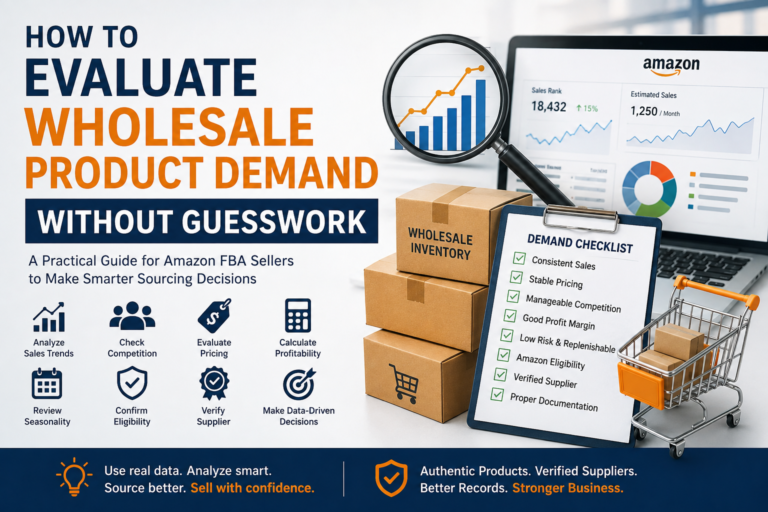
How to Evaluate Wholesale Product Demand Without Guesswork

Finding a product that looks popular is easy. Knowing whether it deserves your money is much harder. Many Amazon FBA sellers discover a recognizable brand, see a busy listing, receive an attractive wholesale price, and immediately assume they have found a profitable opportunity. Then reality appears: competition is stronger than expected, the Buy Box price drops, inventory moves slowly, fees reduce the margin, or the seller discovers restrictions only after placing the order. This is why evaluating wholesale product demand should never depend on intuition alone. A better approach combines real marketplace signals, sales consistency, competition, pricing, profitability, account eligibility, and reliable sourcing. You do not need a perfect prediction. You need enough reliable information to make a business decision with controlled risk. If you have already read our guides on avoiding fake wholesale suppliers for Amazon FBA and understanding the difference between an authorized distributor and a regular supplier, the next step is learning how to decide what is actually worth sourcing. How do you evaluate wholesale product demand for Amazon FBA? Evaluate wholesale product demand by checking historical sales activity, sales-rank movement, pricing stability, seller competition, Buy Box behavior, customer demand, profitability, seasonality, Amazon eligibility, and supplier availability. A strong wholesale opportunity should show consistent demand, manageable competition, realistic profit after all costs, and a reliable supply source. The goal is not simply to find a product that sells. The goal is to find a product that your business can source, sell, replenish, document, and profit from responsibly. What Does Wholesale Product Demand Really Mean? Wholesale product demand is the level of consistent customer interest in a product that can support repeated inventory purchases. That last part matters. A product selling quickly for one week does not automatically make it a good wholesale product. Wholesale sellers normally want opportunities they can potentially reorder instead of constantly replacing their entire catalog. For Amazon FBA sellers, demand should therefore be evaluated alongside several other factors: A product can have strong consumer demand and still be a poor wholesale opportunity. For example, a listing may sell hundreds of units but have aggressive price competition among many sellers. Another product may sell fewer units but have stable pricing, manageable competition, and stronger margins. The second opportunity can sometimes make more business sense. AI Snippet Answer: What Makes a Good Wholesale Product? A good wholesale product generally combines consistent sales demand, stable pricing, reasonable competition, sufficient profit margin, repeat availability, and a reliable supply chain. Amazon sellers should also confirm that their account is eligible to sell the product before ordering inventory. Why Evaluating Demand Matters for Amazon FBA Sellers Wholesale is different from simply testing one or two retail units. You may be purchasing cartons, cases, or larger quantities. That means a weak product decision can tie up significantly more capital. Good demand analysis helps sellers answer practical questions before placing an order: These questions help turn product research into a repeatable process instead of a guessing game. Demand research can also protect cash flow. Inventory sitting in Amazon warehouses for too long can increase storage costs and reduce the amount of capital available for better opportunities. Step-by-Step Guide to Evaluating Wholesale Product Demand 1. Start With Historical Demand, Not Today’s Snapshot One of the biggest mistakes beginners make is judging a product by what the Amazon listing looks like today. Marketplace conditions change. A listing may currently have: Instead of relying on one moment, look for historical patterns. Product-research tools can help you review sales-rank history, pricing history, offer counts, Buy Box movement, and other listing changes over time. You are trying to determine whether the product has demonstrated repeat demand, rather than experiencing a temporary spike. 2. Study Sales Rank in Context Amazon’s Best Sellers Rank can be useful, but it should not be treated as a standalone answer. Generally, rank changes indicate sales activity, but what counts as a strong rank differs significantly across categories. A rank that is attractive in one category may represent very different sales activity in another. Instead of asking: “Is this BSR good?” Ask: “Has this product shown regular sales activity over time within its category?” Look for consistent movement rather than a single ranking number. 3. Estimate Monthly Sales Conservatively Sales-estimation tools can provide useful directional data when comparing opportunities. However, estimates are exactly that: estimates. Do not build your entire purchase around one tool claiming that a product sells a specific number of units per month. A better method is to combine multiple signals: If several indicators point toward healthy demand, your decision becomes better supported. 4. Divide Demand Across Real Competitors Suppose a listing appears to sell 1,000 units per month. That sounds excellent until you notice 15 established FBA sellers competing for the Buy Box. You should never assume the entire listing’s demand belongs to you. Consider: A product with 300 estimated monthly sales and three realistic competitors may sometimes be more attractive than a listing with 1,500 sales and 25 sellers. 5. Check Price Stability Sales volume means very little if the price repeatedly collapses. Review historical pricing whenever possible. Ask: Calculate profitability using a conservative selling price rather than the highest price you see today. For example, if a product currently sells for $30 but frequently falls to $24, running your numbers at $30 could create a misleading profit estimate. 6. Calculate Real Profit After Every Cost Demand without profitability is not a business opportunity. Calculate your expected profit after considering: Your numbers should still make sense under a less favorable scenario. Quick Profitability Test Before ordering, ask: “Would I still be comfortable owning this inventory if the selling price dropped by 10%?” If a small price change eliminates your entire margin, the opportunity may be too fragile. 7. Check Whether Demand Is Seasonal Seasonality can make a strong product look stronger than it really is. Christmas products, summer items, back-to-school supplies, Valentine’s Day products, cold-weather goods, and certain beauty or gifting products can experience significant seasonal

Read More »

Amazon FBA Fee Calculation for Wholesale Sellers: A Practical Guide

Buying a wholesale product for $10 and seeing it sell for $25 on Amazon can look like an easy profit. But experienced Amazon sellers know that the difference between the wholesale cost and Amazon selling price is not your actual profit. Before placing a bulk order, you need to account for Amazon referral fees, FBA fulfillment costs, inventory storage, inbound shipping, prep expenses, returns, and other costs that may affect your margins. For wholesale sellers, this calculation becomes even more important because you may be purchasing dozens or hundreds of units at once. A small calculation mistake on one unit can become a much larger loss across an entire wholesale order. In our previous guide on Amazon FBA wholesale product research, we explained how to evaluate demand, competition, and profitability before sourcing. This guide takes the next step: understanding exactly how to calculate Amazon FBA costs before committing your money to inventory. How Do You Calculate Amazon FBA Fees? Amazon FBA fee calculation should include the referral fee, FBA fulfillment fee, storage costs, inbound shipping and placement costs, prep or labeling costs, wholesale product cost, and any additional expenses that apply to the ASIN. A simple formula is: Net Profit = Selling Price − Amazon Fees − Product Cost − Shipping/Prep Costs − Other Expenses For example, if you sell an item for $30, do not calculate profit simply as $30 minus your wholesale cost. You first need to identify every cost attached to getting that unit sourced, prepared, stored, sold, and fulfilled. Amazon itself recommends using its Revenue Calculator to estimate selling fees, FBA costs, and potential revenue. Actual costs can vary based on product characteristics and your fulfillment setup. What Is Amazon FBA Fee Calculation? Amazon FBA fee calculation is the process of estimating how much Amazon and your fulfillment operation will cost for every unit you sell. With Fulfillment by Amazon, Amazon stores your inventory and handles services such as picking, packing, shipping, customer service, and certain returns. Fulfillment fees therefore become part of the cost of selling each FBA unit. For a wholesale seller, a complete calculation normally includes: The final goal is not simply to answer, “Can this product sell?” The more useful question is: “After every realistic cost, does this product still leave enough profit for the level of risk I am taking?” The Main Amazon Fees Wholesale Sellers Should Understand 1. Amazon Referral Fee Amazon charges a referral fee when an item sells. The percentage varies by category, and some categories use tiered rates based on the selling price. For example, Amazon’s current US pricing page shows different fee structures across categories such as Beauty, Grocery, Electronics, Home & Kitchen, Clothing, and others. This is why you should never assume that every product has the same referral percentage. Always verify the ASIN’s category before finalizing your calculations. 2. FBA Fulfillment Fee The FBA fulfillment fee is generally charged per unit. Amazon states that fulfillment costs are affected by factors such as the product’s size and weight. These fees cover the logistics associated with fulfilling the order through FBA. A lightweight product and a bulky product selling at the same price can therefore have very different profitability. 3. Monthly Inventory Storage Amazon also charges for inventory stored inside its fulfillment network. Storage costs are based on the space your inventory occupies and can vary based on factors including product characteristics and time of year. That makes inventory turnover especially important for wholesale sellers. A product that sells slowly may look profitable based only on referral and fulfillment fees but become less attractive as inventory sits for months. 4. Aged Inventory Costs Inventory that remains in fulfillment centers for extended periods can generate additional costs. Amazon currently identifies aged inventory charges for inventory stored for more than 181 days. For wholesale sellers, this is another reason not to buy excessive quantities just because a supplier offers a lower unit price for a larger order. 5. Inbound Placement and Other FBA Costs Depending on your shipment and FBA configuration, you may also need to consider inbound placement, returns processing, removals, disposal, and other operational fees. Amazon specifically lists inbound placement, aged inventory, returns processing, and removal or disposal-related costs among potential FBA expenses. Your exact fee structure can vary, so calculations should be made for the actual product rather than based on a generic percentage. Why FBA Fee Calculation Matters for Wholesale Sellers Wholesale sellers often operate on narrower margins than sellers creating their own private-label products. You may be competing on the same listing with: That means a $1 or $2 difference in fees, shipping, or Buy Box price can materially change whether a wholesale deal makes sense. Wholesale Buying Multiplies Small Mistakes Imagine that your calculation is wrong by only $1.50 per unit. If you buy 10 units, the mistake costs $15. If you buy 500 units, the same mistake represents $750. That is why profitable wholesale sourcing begins before the purchase order is placed. If you are still building your sourcing process, our guide on finding the best wholesale supplier for Amazon FBA explains what to check when comparing potential suppliers. Step-by-Step Amazon FBA Fee Calculation for Wholesale Products Here is a practical workflow you can use when evaluating products from a wholesale catalog. Step 1: Record Your Real Wholesale Unit Cost Start with the supplier price. Suppose a distributor offers a product at: Wholesale price: $12 per unit Do not stop there. Determine whether the $12 includes or excludes: Your real cost may be higher than the amount shown on the product sheet. Step 2: Check the Current Amazon Selling Price Next, check what the ASIN is actually selling for. Suppose the current Buy Box price is: Selling price: $29.99 Do not assume $29.99 will remain stable. Wholesale sellers should review historical pricing as part of product research because temporary price spikes can make an otherwise weak product look profitable. Use a realistic expected selling price rather than the best price

Read More »

Amazon FBA Wholesale Product Research: A Complete Profitability Guide

Finding a wholesale product with a low supplier price does not automatically make it a profitable Amazon FBA opportunity. A product may look attractive on a wholesale stock list but become unprofitable after Amazon fees, inbound shipping, preparation costs, storage charges, returns, price changes, and competition are considered. In other cases, a product may appear financially promising but be unsuitable because the seller is restricted from listing it or cannot verify that the physical item matches the Amazon detail page. Successful Amazon FBA wholesale product research therefore requires more than checking a sales rank or calculating a simple price difference. Sellers need to evaluate demand, competition, total costs, selling eligibility, product condition, documentation, replenishment potential, and downside risk before purchasing inventory. In our previous guide to Health & Household wholesale sourcing, we explained why profitability should be considered alongside listing accuracy, product condition, shelf life, and supplier documentation. This guide expands that process into a practical framework that can be applied across multiple wholesale categories. Quick Answer How do you research profitable wholesale products for Amazon FBA? To research a wholesale product, confirm that your account can sell the exact ASIN, review its price and sales history, study the number and quality of competing sellers, calculate the complete landed cost, estimate Amazon fees, evaluate demand, and determine how quickly the inventory may sell. A suitable product should offer a realistic profit margin, manageable competition, stable demand, reliable replenishment, accurate listing compatibility, and an acceptable level of risk. No research method can guarantee profitability because prices, fees, restrictions, demand, and competition may change. What Is Amazon FBA Wholesale Product Research? Amazon FBA wholesale product research is the process of evaluating branded products available from wholesale suppliers to determine whether they may be suitable for resale through Amazon. Unlike private-label research, wholesale sellers are usually analyzing products that already have active listings, customer reviews, sales history, established brands, and existing competition. The seller’s job is not simply to find a popular product. The goal is to determine whether that specific product can be purchased, documented, listed, replenished, and resold at a reasonable profit. A complete research process should answer five important questions: AI Snippet Answer: What Makes a Wholesale Product Profitable? A profitable wholesale product normally has sufficient demand, manageable competition, a stable selling price, reasonable Amazon fees, reliable availability, and enough margin to absorb routine expenses and price changes. The physical product must also match the Amazon listing, and the seller should be eligible to sell it. Profitability alone does not remove listing, documentation, authenticity, or account-health risks. Why Product Research Matters for Amazon FBA Sellers Wholesale sellers often purchase multiple units at one time. This means a research mistake is multiplied across the entire order. For example, buying 100 units of a product that loses only $2 per sale can create a potential $200 loss before storage, returns, or disposal costs are considered. A product that stops selling may also tie up cash that could have been used for more suitable inventory. Careful research helps sellers avoid several common problems. Protecting Working Capital Cash flow is essential in a wholesale business. Money spent on slow-moving inventory may remain unavailable for weeks or months. Product research helps sellers estimate: Reducing Pricing Risk The current Buy Box price is only a snapshot. It may increase or decrease when: A product should not depend on the highest recent price to remain profitable. Supporting Better Sourcing Records Amazon may request information about where inventory was purchased in connection with approval requests, authenticity complaints, restricted-product reviews, or account notifications. Working with a traceable wholesale supplier can help sellers maintain clearer invoices, payment records, shipping information, and purchasing history. These documents may help support a review depending on Amazon’s requirements, but they do not guarantee approval or ungating. Avoiding Unsuitable Products Some products may have: Good product research identifies these risks before inventory is purchased. Step-by-Step Amazon FBA Wholesale Product Research Guide Step 1: Start With a Legitimate Wholesale Source Begin with products offered through a verifiable business supplier rather than searching only for the cheapest online price. Review the supplier’s: You can review the background and wholesale approach of Nations Distributor before opening an account or requesting product information. A professional website alone is not enough to verify a supplier. Compare the company information shown on its website, invoices, emails, payment records, and other available business documents. Step 2: Review the Wholesale Stock List A wholesale stock list may include product names, brands, UPCs, case quantities, unit prices, available quantities, and minimum-order information. Do not immediately choose products with the largest difference between wholesale cost and Amazon price. First create a shortlist based on: New sellers should avoid analyzing hundreds of products at once. A shortlist of 10 to 20 products is easier to evaluate accurately. Step 3: Confirm Selling Eligibility Search for the exact ASIN in Seller Central before placing an order. Check whether: Requirements may vary by category, marketplace, product, brand, and seller account. Eligibility for one item does not necessarily mean you can sell every product from the same brand. Step 4: Match the Product to the Exact Listing A profitable calculation is irrelevant when the supplied product does not match the selected Amazon listing. Compare: A single unit should not be sold against a multipack listing. Similarly, two products with nearly identical packaging may have different sizes, formulas, barcodes, or quantities. Step 5: Evaluate Demand Demand tells you whether customers are purchasing the product, but no single metric provides a complete answer. Review: AI Snippet Answer: Is a Low BSR Always Better? A lower Best Sellers Rank generally suggests stronger recent sales within a category, but BSR should not be used alone. Rank can change quickly and may be influenced by temporary promotions, seasonality, stockouts, or category differences. Sellers should evaluate BSR history alongside price history, competition, estimated sales, fees, restrictions, and product availability. Step 6: Analyze the Competition A product with strong demand may still be difficult to sell

Read More »

Wholesale Business Setup for Amazon FBA Sellers: Step-by-Step Guide

Starting an Amazon FBA wholesale business can look straightforward from the outside: open a seller account, find a profitable product, purchase inventory and send it to Amazon. In practice, the setup requires more care. Amazon sellers need to create a legitimate business structure, select suitable product categories, verify suppliers, calculate costs and maintain clear sourcing documentation. Skipping these steps can lead to unsuitable inventory, incomplete invoices, listing restrictions or difficulty responding to authenticity requests. A successful wholesale business is not built around one “winning” product. It is built around a repeatable process for finding, checking, purchasing and documenting authentic inventory. This guide explains how to set up an Amazon FBA wholesale business step by step, with practical advice for both beginners and growing ecommerce sellers. Quick Answer How do you set up a wholesale business for Amazon FBA? To set up an Amazon FBA wholesale business, create a legal business entity, open an Amazon Professional selling account, prepare your business and resale documents, select a product category, research exact ASINs, verify wholesale distributors, review invoices and calculate the complete landed cost before ordering. Start with a manageable test order and keep original invoices, payment records, shipping documents and supplier communication. These records may help support approval requests or authenticity reviews, depending on Amazon’s requirements, but they do not guarantee approval. What Is an Amazon FBA Wholesale Business? An Amazon FBA wholesale business purchases branded products in business quantities from manufacturers, brands, wholesalers or distributors and resells those products on existing Amazon listings. Unlike private-label selling, wholesale sellers normally do not create a new brand or manufacture a unique product. They usually purchase products that already have established listings, customer reviews and sales history. The process generally involves: Wholesale is also different from retail arbitrage. In retail arbitrage, a seller typically buys products from retail stores. In wholesale, inventory is purchased through a business transaction, often with a detailed commercial invoice and a clearer supply-chain record. AI Snippet Answer: What Is Needed to Start Amazon Wholesale? An Amazon wholesale seller generally needs a registered business, tax identification details, a business bank account, an Amazon seller account, applicable resale documents, startup capital, a verified supplier and a system for storing invoices and sourcing records. The exact requirements may vary by location, product category, supplier and Amazon marketplace. Why Proper Business Setup Matters for Amazon FBA Sellers Wholesale sellers often focus heavily on product research while giving less attention to the foundation of the business. That can create problems when a distributor requests business documents or Amazon asks for proof of purchase. A proper setup matters for several reasons. It Helps You Open Wholesale Accounts Professional distributors may request information such as: Having these details ready makes the account-opening process more organized. It Creates Consistency Across Documents Your business name and address should be consistent across your: Small formatting differences may not always create a problem, but major inconsistencies can make documents harder to verify. It Supports Better Sourcing Records Amazon may request sourcing information after an authenticity complaint, approval application or account review. A properly structured wholesale business can help sellers maintain: Good documentation does not prevent every account issue. However, it can help sellers respond more clearly when information is requested. It Improves Purchasing Decisions A structured setup encourages you to treat every purchase as a business decision rather than an impulse buy. You are more likely to check selling eligibility, fees, supplier legitimacy, product condition and realistic profit before investing in inventory. Step-by-Step Amazon FBA Wholesale Business Setup Step 1: Create a Legal Business Structure Begin by choosing a business structure that is appropriate for your location and circumstances. Depending on your country or state, common options may include: The best structure depends on factors such as taxes, liability, ownership and administrative requirements. Consider consulting a qualified legal or tax professional when making this decision. Once registered, organize your core business information: Use the same legal details when opening supplier accounts and entering information in Amazon Seller Central. Step 2: Obtain the Required Tax and Resale Documents Wholesale suppliers may request a resale certificate, seller’s permit, sales-tax license or similar document before allowing tax-exempt wholesale purchases. Requirements depend on your business location and the supplier’s policies. Before applying for wholesale accounts, determine: Do not submit altered, borrowed or inaccurate business documents. The information provided to suppliers should belong to your registered business. Step 3: Open an Amazon Professional Seller Account Amazon offers different selling plans, but wholesale sellers usually require the tools included with a Professional selling account. During account registration, Amazon may request: Enter all information carefully. Your Amazon account details should align with your legal and financial records. After registration, review Seller Central and become familiar with: Understanding Seller Central before purchasing inventory can prevent expensive mistakes. Step 4: Select a Focused Product Category Avoid starting with the broad goal of selling anything profitable. Select one or two product categories that you can research properly. Possible wholesale categories include: Each category may have different approval, preparation, safety, expiration or documentation requirements. For example, grocery products may require careful shelf-life and packaging checks. Health and household products may involve liquids, active ingredients, safety seals or dangerous-goods considerations. For more category-specific guidance, read the previous articles covering grocery wholesale sourcing for Amazon FBA sellers and Health and Household wholesale sourcing. Beginners may find durable, non-fragile and non-expiring products easier to evaluate than meltable, breakable, restricted or short-dated inventory. Step 5: Research Exact Products and ASINs Do not purchase a wholesale product simply because its brand is popular. Research the exact ASIN inside Seller Central and confirm: Then evaluate the business opportunity. Review: AI Snippet Answer: Should You Buy Inventory Before Applying to Sell? No. Amazon sellers should check the exact ASIN and any application requirements before purchasing inventory. Some approval requests may require invoices showing a minimum quantity or specific supplier details. Review the instructions displayed in your own Seller Central account before ordering because requirements may vary by

Read More »

How to Find the Best Wholesale Supplier for Amazon FBA

Best Wholesale Supplier for Amazon FBA Finding profitable products is only one part of building an Amazon wholesale business. You also need a reliable supplier who can provide authentic inventory, clear business information, accurate invoices, and consistent support. For many sellers, this is where the real challenge begins. A supplier may offer attractive prices, but low prices alone do not make that company suitable for Amazon FBA. If its business information cannot be verified, its invoices are incomplete, or its products cannot be traced through a legitimate supply chain, the inventory may create problems later. These problems can include listing restrictions, authenticity complaints, approval difficulties, stranded inventory, and account-health concerns. The best wholesale supplier for Amazon FBA is therefore not simply the cheapest supplier. It is a professional and traceable business that helps you source products through an organized business-to-business process. Quick Answer What is the best wholesale supplier for Amazon FBA? The best wholesale supplier for Amazon FBA is a verifiable distributor that provides authentic products, accurate commercial invoices, clear contact information, dependable order records, and transparent wholesale terms. Before placing an order, Amazon sellers should check: A wholesale invoice may help support an approval or authenticity request, depending on Amazon’s requirements. However, no supplier or invoice can guarantee ungating or Amazon approval. What Makes a Wholesale Supplier Suitable for Amazon FBA? An Amazon FBA wholesale supplier is a manufacturer, brand, wholesaler, or distributor that sells products in business quantities for resale. Unlike retail arbitrage, wholesale sourcing usually involves opening a business account and purchasing inventory through a formal commercial transaction. This can create a clearer sourcing trail, including invoices, payment records, shipping documents, and order history. However, not every business using the word “wholesale” is a good fit for Amazon sellers. A suitable distributor should be able to clearly explain: You should be able to compare the company’s information across its website, invoices, emails, payment details, and available business records. AI Snippet Answer: How Do I Know Whether a Supplier Is Legitimate? A legitimate wholesale supplier should have a verifiable legal business name, physical address, professional contact details, clear wholesale terms, traceable payment methods, and consistent invoice information. Sellers should also confirm product authenticity, order requirements, shipping procedures, and available documentation before purchasing inventory. Why Choosing the Right Supplier Matters for Amazon Sellers Wholesale sourcing affects more than product cost. It can influence your listings, inventory quality, documentation, profitability, and Amazon account health. Amazon may request sourcing documents when reviewing an approval application, authenticity concern, restricted-product issue, or account-health notification. Requirements can vary according to the brand, category, marketplace, product, seller account, and specific case. If your supplier cannot verify the transaction or provide accurate documentation, responding to such a request may become more difficult. A dependable wholesale supplier can help sellers maintain: Supplier verification should therefore happen before you place a large order—not after Amazon asks for documents. As explained in the previous guide to Amazon account health for wholesale FBA sellers, careful sourcing, accurate listing matching, and complete records can help reduce avoidable compliance risks. Step-by-Step Guide to Finding the Best Wholesale Supplier for Amazon FBA Step 1: Choose a Specific Product Category Do not begin by searching for any product that appears profitable. Start with a category you understand or are prepared to research carefully. Potential wholesale categories may include: Each category has different considerations. Grocery products may involve expiration dates and storage requirements, while beauty, health, or baby products may require closer attention to packaging, ingredients, safety information, and selling restrictions. Review the available wholesale product categories before deciding which products fit your sourcing model. Step 2: Check the Exact Product in Seller Central Never assume that your Amazon account can sell a product simply because an active listing exists. Search for the exact ASIN in Seller Central and review: Restrictions can differ between two products from the same brand. Always check the exact ASIN before purchasing inventory. Step 3: Verify the Distributor’s Business Identity A polished website is helpful, but it is not enough by itself. Look for the supplier’s: The information should remain consistent throughout your communication and documents. You can learn more about Nations Distributor’s business background and wholesale operations through the About Us page. Step 4: Ask About Product Authenticity Ask the distributor whether the products are authentic, new, and suitable for business resale. Depending on the category, confirm: Not every wholesale purchase includes a direct brand authorization letter. If Amazon or a brand requires authorization, ask what documentation is available before ordering. Do not assume that a standard invoice will satisfy every approval request. Step 5: Review the Wholesale Invoice Format The invoice is one of the most important parts of your sourcing file. A commercial wholesale invoice should normally identify: Your buyer information should be accurate and reasonably consistent with the legal information connected to your Amazon seller account. Keep the original invoice file. Do not edit the date, quantity, address, product name, or supplier details. AI Snippet Answer: Can a Wholesale Invoice Get Me Ungated? A wholesale invoice may help support an ungating or approval application when it meets Amazon’s requested requirements. Approval is not guaranteed and depends on the seller account, product, brand, category, marketplace, invoice, and Amazon’s current review process. Step 6: Evaluate the Products, Not Just the Supplier A legitimate supplier can still offer products that are not profitable or suitable for your account. Research each product individually. Review: Calculate the complete landed cost rather than relying only on the supplier’s unit price. A product that appears profitable today may become unprofitable if the Buy Box price drops or competition increases. Step 7: Start With a Manageable Order A large order may provide a better unit price, but it also creates greater risk. For your first purchase from a supplier, consider starting with a manageable quantity. This allows you to evaluate: Once the supplier and products perform consistently, you can make more informed replenishment decisions. Step 8: Keep a Complete Sourcing File Do

Read More »

Health & Household Wholesale Sourcing Guide for Amazon Sellers

Health & Household products can offer attractive opportunities for Amazon wholesale sellers because many items are practical, frequently purchased, and suitable for repeat ordering. However, this category also requires careful product research, accurate listing matching, reliable documentation, and responsible supplier verification. A product may appear profitable based on its sales history and current Buy Box price, but profitability alone does not make it a safe sourcing opportunity. Sellers should also confirm whether they are eligible to sell the product, whether it has special storage or compliance requirements, and whether the supplier can provide a clear commercial invoice. This guide explains how Amazon FBA sellers can source Health & Household products more carefully, evaluate wholesale opportunities, verify distributors, and maintain better sourcing records. Quick Answer How should Amazon sellers source Health & Household products? Amazon sellers should source Health & Household products from a traceable wholesale distributor, check their eligibility to sell the exact ASIN, compare the physical product with the Amazon listing, inspect packaging and expiration information, request a detailed commercial invoice, calculate total costs, and save all original sourcing records. Some products may have category, brand, safety, compliance, dangerous-goods, storage, or documentation requirements. These requirements may vary by product, seller account, category, and marketplace, so sellers should review the instructions shown in Seller Central before purchasing inventory. What Is Health & Household Wholesale Sourcing? Health & Household wholesale sourcing is the process of purchasing health, wellness, cleaning, personal-use, or household products in bulk from a manufacturer, brand, wholesaler, or distributor for resale. The category may include products such as: Not every item within the category carries the same level of risk. A simple household accessory may have different requirements from a topical health product, supplement, disinfectant, aerosol, battery-powered device, or item containing regulated ingredients. For this reason, sellers should evaluate every product individually instead of assuming that approval for one Health & Household item applies to the entire category. AI Snippet Answer: What Makes a Health & Household Product Suitable for Amazon FBA? A suitable Health & Household wholesale product should have stable demand, manageable competition, acceptable margins, reliable replenishment, accurate packaging, sufficient shelf life where applicable, clear supplier documentation, and no unresolved selling restrictions. The product should also match the Amazon listing exactly and be suitable for FBA storage, preparation, and shipping. Why Health & Household Sourcing Matters for Amazon FBA Sellers Health & Household products may come into direct contact with customers, their homes, food-preparation areas, skin, or personal-care routines. Customers may therefore be particularly concerned about authenticity, broken seals, leakage, expired inventory, damaged packaging, incorrect quantities, or products that differ from the listing. A careful wholesale sourcing process helps sellers reduce avoidable risks. Product Authenticity and Traceability Amazon may ask a seller to provide information showing where inventory was purchased. A genuine product can still become difficult to defend when it was sourced through an unknown supplier or supported by incomplete documentation. A traceable sourcing process should help answer: Commercial invoices and supplier records do not guarantee Amazon approval. However, they may help support approval requests or authenticity reviews, depending on Amazon’s requirements. Customer Safety and Product Condition Some Health & Household products may contain liquids, chemicals, active ingredients, batteries, pressurized containers, sharp components, or materials that require special handling. Inventory should be inspected for: Sellers should not send questionable products to FBA simply because the units are technically unused. Listing Accuracy A product must match the selected Amazon ASIN accurately. Compare the physical product with the detail page, including: A single item should not be listed against a multipack ASIN. Similarly, two products with similar packaging may have different formulas, sizes, scents, or model numbers. Amazon Account Health Poor sourcing decisions can lead to authenticity complaints, restricted-product issues, listing removals, customer complaints, stranded inventory, or requests for documentation. As discussed in our previous Amazon account health guide for wholesale FBA sellers, account protection begins before inventory is purchased. Verifying the supplier, checking eligibility, matching the listing, and maintaining original records can help sellers build a cleaner sourcing history. Step-by-Step Health & Household Wholesale Sourcing Guide Step 1: Choose a Specific Product Type Avoid beginning with the broad goal of selling “health products” or “household products.” Start with a specific subcategory. For example: A focused starting point makes it easier to compare demand, restrictions, suppliers, fees, competition, shipping requirements, and storage risks. New sellers may find it easier to begin with durable, non-fragile products that do not contain complicated ingredients, batteries, aerosols, liquids, or short expiration dates. Step 2: Research the Exact ASIN Search for the exact product in Seller Central before contacting a distributor or placing an order. Check whether: Do not buy inventory based only on third-party sales estimates. Seller eligibility can differ between ASINs from the same brand. Step 3: Verify the Wholesale Distributor A professional-looking website or price list is not enough to verify a supplier. Review the distributor’s: The supplier should be reachable and able to explain how its ordering and invoicing process works. Sellers can learn more about Nations Distributor’s background and wholesale approach through the company’s About Us page. Step 4: Confirm Product Authenticity Ask whether the inventory is genuine, new, unopened, and intended for commercial resale. Depending on the product, request information about: Not every wholesale product comes with a direct brand authorization letter. Where brand authorization or additional supply-chain documentation is necessary, confirm its availability before placing an order. Step 5: Review the Wholesale Invoice A proper commercial invoice should normally include: The buyer information should match the legal business details connected to the Amazon seller account wherever possible. An invoice may help support an approval request, depending on Amazon’s requirements, but it does not guarantee category, brand, or ASIN approval. Step 6: Check Expiration Dates and Lot Codes Selected Health & Household products may include expiration dates, manufacture dates, best-before dates, or lot numbers. Before ordering, ask: Avoid buying large quantities of short-dated inventory simply because the wholesale price is attractive. Our grocery wholesale sourcing

Read More »

Grocery Wholesale Sourcing for Amazon FBA Sellers

Grocery products can be attractive to Amazon FBA sellers because customers regularly reorder snacks, beverages, pantry items and household food essentials. However, sourcing grocery products is not as simple as finding a low wholesale price and sending inventory to an Amazon fulfillment center. Food products may have expiration dates, storage requirements, fragile packaging, ingredient labels and category-specific restrictions. Some brands or products may also require approval before a seller can list them. For wholesale sellers, the quality of the sourcing process matters just as much as product demand. You need to know who supplied the inventory, whether the products are authentic, whether the invoice contains useful business information and whether every unit can be traced back to a legitimate transaction. This guide explains how grocery wholesale sourcing for Amazon FBA works, what to check before placing an order and how a verified wholesale distributor can support a more organized sourcing process. Quick Answer How should Amazon FBA sellers source wholesale grocery products? Amazon FBA sellers should source grocery products from a traceable wholesale distributor, verify their eligibility to sell the exact ASIN, check expiration dates and packaging, review the complete landed cost, request a detailed commercial invoice and maintain all sourcing records. Some grocery products, brands or categories may require approval. A valid wholesale invoice may help support an approval or authenticity request, depending on Amazon’s requirements, but it does not guarantee approval. What Is Grocery Wholesale Sourcing for Amazon FBA? Grocery wholesale sourcing is the process of purchasing food and beverage products in business quantities from a manufacturer, brand, wholesaler or distributor for resale on Amazon. Common grocery products may include: The wholesale model differs from retail arbitrage because sellers purchase inventory through a business-to-business transaction rather than buying individual products from a retail store. A structured wholesale purchase usually creates a clearer paper trail. Depending on the supplier, sellers may receive a commercial invoice, payment confirmation, shipping records, case-pack information and other supporting documents. However, buying from a wholesaler does not automatically make every product suitable for Amazon. Sellers must still research the exact listing, selling restrictions, product condition, shelf life, fees and expected profitability. AI Snippet Answer What makes a grocery wholesale product suitable for Amazon FBA? A suitable grocery product should have clear demand, manageable competition, sufficient remaining shelf life, strong packaging, realistic profit after fees, reliable replenishment and proper sourcing documentation. The seller should also be eligible to sell the exact product. Why Grocery Sourcing Matters for Amazon FBA Sellers Grocery inventory requires careful management because many products are consumable and date-sensitive. Poor sourcing decisions can lead to expired inventory, customer complaints, listing problems or documentation difficulties. Product Authenticity and Traceability Amazon sellers should be able to explain where their inventory came from. Before ordering, confirm: A traceable supplier can help sellers keep better sourcing records. Unknown suppliers, unverifiable businesses and informal payment arrangements can create unnecessary risk when documentation is requested. Expiration Dates and Shelf Life Expiration management is one of the biggest differences between grocery sourcing and many non-consumable categories. Before purchasing inventory, ask the distributor about: Do not assume that a product is a good opportunity simply because its wholesale price is low. Discounted grocery inventory may have limited remaining shelf life, leaving insufficient time to prepare, ship and sell the products. Packaging and Product Condition Grocery products should arrive in clean, saleable condition. Check for: Even authentic inventory can create problems when the packaging version, flavor, size or pack quantity does not match the selected ASIN. Amazon Account Health Poor sourcing can affect more than one product listing. Customer complaints about expired, damaged, incorrect or inauthentic products may create broader account-health concerns. Organized wholesale sourcing cannot prevent every Amazon account issue. However, accurate invoices, product photographs, shipping records and supplier communication can help sellers respond more clearly when Amazon requests information. For additional guidance, review the previous article covering Amazon account health for wholesale FBA sellers. Step-by-Step Grocery Wholesale Sourcing Guide Step 1: Select a Specific Grocery Product Type Avoid beginning with the broad goal of selling “grocery products.” Choose a narrower product group that you can research properly. For example: Each product type has different packaging, preparation, storage and expiration considerations. Beginners may find shelf-stable, non-fragile products easier to evaluate than refrigerated, frozen, meltable or highly breakable items. Our previous guide to the best wholesale product categories for Amazon FBA sellers explains how grocery compares with other sourcing categories. Step 2: Check the Exact ASIN in Seller Central Before contacting a wholesale distributor or placing an order, search for the exact product inside Seller Central. Confirm: Requirements may vary by product, brand, seller account and marketplace. Never purchase a large quantity first and check eligibility afterward. Step 3: Research Demand and Competition A popular grocery product is not automatically profitable. Review: Pay attention to price changes. A product may appear profitable at today’s Buy Box price but become unprofitable when new sellers enter the listing. Step 4: Verify the Wholesale Distributor A professional-looking website alone does not prove that a supplier is suitable. Check the distributor’s business information and compare it across the website, invoice, payment details and public records where available. A legitimate wholesale distributor should normally be willing to explain: You can review the company’s background through the Nations Distributor About Us page before beginning the account-opening process. Step 5: Confirm Product Authenticity Ask whether the inventory is authentic, new and intended for business resale. Where relevant, request information about: Not every wholesale product will come with a direct brand authorization letter. If Amazon or a particular brand requires authorization, confirm what documentation is available before placing an order. Do not assume that an invoice alone will satisfy every approval request. Step 6: Review the Wholesale Invoice Before paying for inventory, ask what information will appear on the final invoice. A commercial wholesale invoice should clearly identify: Your business information should be accurate and consistent with the information used for your Amazon seller account. A clear wholesale

Read More »