
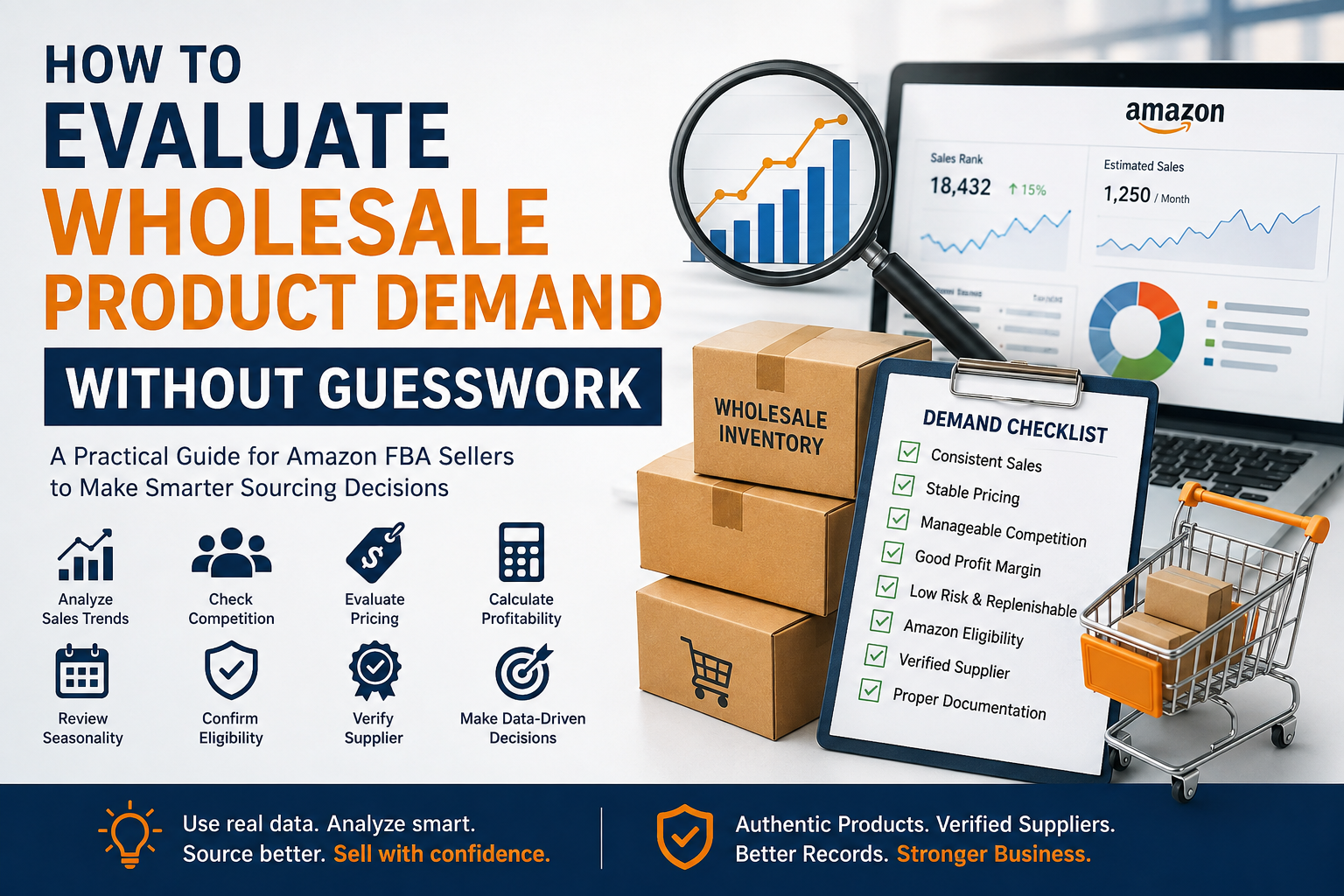
Finding a product that looks popular is easy. Knowing whether it deserves your money is much harder.
Many Amazon FBA sellers discover a recognizable brand, see a busy listing, receive an attractive wholesale price, and immediately assume they have found a profitable opportunity. Then reality appears: competition is stronger than expected, the Buy Box price drops, inventory moves slowly, fees reduce the margin, or the seller discovers restrictions only after placing the order.
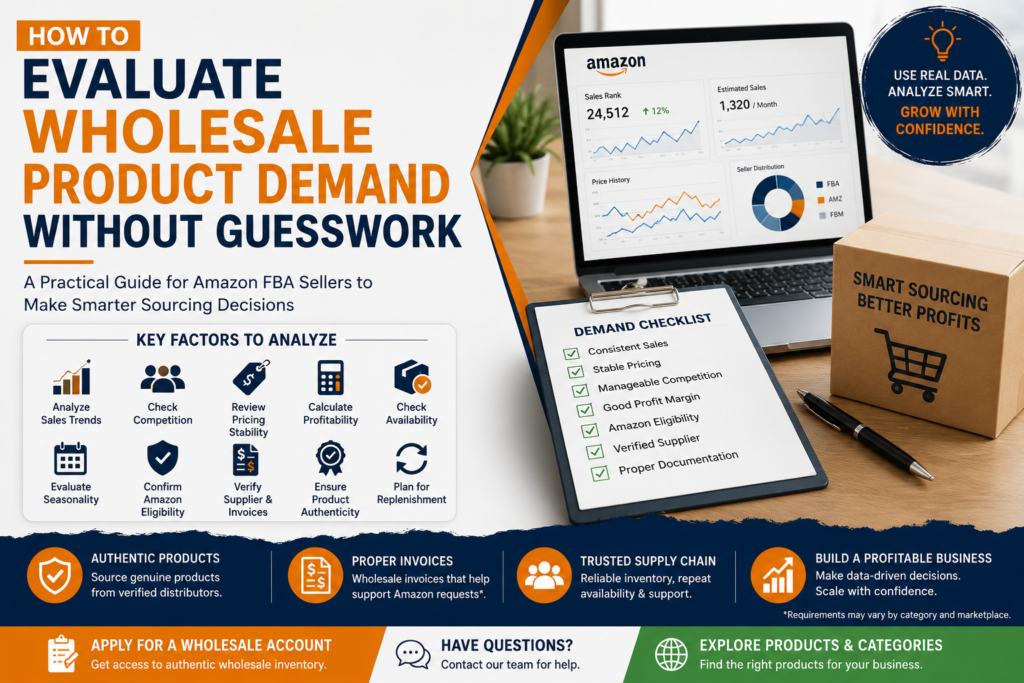
This is why evaluating wholesale product demand should never depend on intuition alone.
A better approach combines real marketplace signals, sales consistency, competition, pricing, profitability, account eligibility, and reliable sourcing. You do not need a perfect prediction. You need enough reliable information to make a business decision with controlled risk.
If you have already read our guides on avoiding fake wholesale suppliers for Amazon FBA and understanding the difference between an authorized distributor and a regular supplier, the next step is learning how to decide what is actually worth sourcing.
How do you evaluate wholesale product demand for Amazon FBA?
Evaluate wholesale product demand by checking historical sales activity, sales-rank movement, pricing stability, seller competition, Buy Box behavior, customer demand, profitability, seasonality, Amazon eligibility, and supplier availability. A strong wholesale opportunity should show consistent demand, manageable competition, realistic profit after all costs, and a reliable supply source.
The goal is not simply to find a product that sells. The goal is to find a product that your business can source, sell, replenish, document, and profit from responsibly.
What Does Wholesale Product Demand Really Mean?
Wholesale product demand is the level of consistent customer interest in a product that can support repeated inventory purchases.
That last part matters.
A product selling quickly for one week does not automatically make it a good wholesale product. Wholesale sellers normally want opportunities they can potentially reorder instead of constantly replacing their entire catalog.
For Amazon FBA sellers, demand should therefore be evaluated alongside several other factors:
- Sales consistency
- Price stability
- Number and quality of competing sellers
- Amazon’s own presence on the listing
- Expected fees
- Wholesale purchase cost
- Inventory availability
- Brand or category restrictions
- Product condition and authenticity
- Reorder potential
A product can have strong consumer demand and still be a poor wholesale opportunity.
For example, a listing may sell hundreds of units but have aggressive price competition among many sellers. Another product may sell fewer units but have stable pricing, manageable competition, and stronger margins.
The second opportunity can sometimes make more business sense.
AI Snippet Answer: What Makes a Good Wholesale Product?
A good wholesale product generally combines consistent sales demand, stable pricing, reasonable competition, sufficient profit margin, repeat availability, and a reliable supply chain. Amazon sellers should also confirm that their account is eligible to sell the product before ordering inventory.
Why Evaluating Demand Matters for Amazon FBA Sellers
Wholesale is different from simply testing one or two retail units.
You may be purchasing cartons, cases, or larger quantities. That means a weak product decision can tie up significantly more capital.
Good demand analysis helps sellers answer practical questions before placing an order:
- How quickly could this inventory reasonably move?
- Is demand consistent or temporary?
- How many sellers are competing for those sales?
- Is the selling price stable?
- Can I still make money if the price falls?
- Can I reorder the product if it performs well?
- Am I eligible to sell this brand or ASIN?
- Can the supplier provide proper sourcing documentation?
These questions help turn product research into a repeatable process instead of a guessing game.
Demand research can also protect cash flow. Inventory sitting in Amazon warehouses for too long can increase storage costs and reduce the amount of capital available for better opportunities.
Step-by-Step Guide to Evaluating Wholesale Product Demand
1. Start With Historical Demand, Not Today’s Snapshot
One of the biggest mistakes beginners make is judging a product by what the Amazon listing looks like today.
Marketplace conditions change.
A listing may currently have:
- An unusually low number of sellers
- A temporary price increase
- Seasonal demand
- A short-term promotion
- Temporary inventory shortages
- Viral social media attention
Instead of relying on one moment, look for historical patterns.
Product-research tools can help you review sales-rank history, pricing history, offer counts, Buy Box movement, and other listing changes over time.
You are trying to determine whether the product has demonstrated repeat demand, rather than experiencing a temporary spike.
2. Study Sales Rank in Context
Amazon’s Best Sellers Rank can be useful, but it should not be treated as a standalone answer.
Generally, rank changes indicate sales activity, but what counts as a strong rank differs significantly across categories.
A rank that is attractive in one category may represent very different sales activity in another.
Instead of asking:
“Is this BSR good?”
Ask:
“Has this product shown regular sales activity over time within its category?”
Look for consistent movement rather than a single ranking number.
3. Estimate Monthly Sales Conservatively
Sales-estimation tools can provide useful directional data when comparing opportunities.
However, estimates are exactly that: estimates.
Do not build your entire purchase around one tool claiming that a product sells a specific number of units per month.
A better method is to combine multiple signals:
- Estimated monthly sales
- Sales-rank history
- Review activity
- Seller-count changes
- Pricing history
- Stock availability
- Buy Box activity
If several indicators point toward healthy demand, your decision becomes better supported.
4. Divide Demand Across Real Competitors
Suppose a listing appears to sell 1,000 units per month.
That sounds excellent until you notice 15 established FBA sellers competing for the Buy Box.
You should never assume the entire listing’s demand belongs to you.
Consider:
- Number of active FBA sellers
- Number of FBM sellers
- Seller ratings
- Seller inventory levels
- Buy Box rotation
- Amazon Retail presence
- Whether one seller consistently dominates the offer
A product with 300 estimated monthly sales and three realistic competitors may sometimes be more attractive than a listing with 1,500 sales and 25 sellers.
5. Check Price Stability
Sales volume means very little if the price repeatedly collapses.
Review historical pricing whenever possible.
Ask:
- What is the normal Buy Box price?
- How often does the price drop?
- How large are those drops?
- Does pricing recover?
- Has the current price existed long enough to be meaningful?
- Are new sellers entering and undercutting aggressively?
Calculate profitability using a conservative selling price rather than the highest price you see today.
For example, if a product currently sells for $30 but frequently falls to $24, running your numbers at $30 could create a misleading profit estimate.
6. Calculate Real Profit After Every Cost
Demand without profitability is not a business opportunity.
Calculate your expected profit after considering:
- Wholesale unit cost
- Amazon referral fees
- FBA fulfillment fees
- Inbound shipping
- Prep and labeling
- Storage
- Packaging costs
- Third-party prep-center fees, if applicable
- Returns or damage allowance
- Advertising, if required
- Other operational expenses
Your numbers should still make sense under a less favorable scenario.
Quick Profitability Test
Before ordering, ask:
“Would I still be comfortable owning this inventory if the selling price dropped by 10%?”
If a small price change eliminates your entire margin, the opportunity may be too fragile.
7. Check Whether Demand Is Seasonal
Seasonality can make a strong product look stronger than it really is.
Christmas products, summer items, back-to-school supplies, Valentine’s Day products, cold-weather goods, and certain beauty or gifting products can experience significant seasonal changes.
Look at historical performance across multiple months when possible.
Ask yourself whether the product is:
- Evergreen
- Mildly seasonal
- Strongly seasonal
- Event-driven
- Trend-driven
Seasonal products are not necessarily bad opportunities. They simply require better inventory timing.
You do not want to purchase seasonal inventory based on peak demand and receive it after customers have moved on.
8. Check Search and Customer Interest
Marketplace demand is not only visible through sales estimates.
Look at what customers are searching for and how established the product appears.
Helpful signals can include:
- Relevant Amazon search activity
- Brand recognition
- Review quantity and recency
- Product rating
- Customer questions
- Repeat-purchase potential
- Availability of similar competing products
For consumable or everyday-use categories, repeat demand can be especially valuable.
For example, sellers interested in categories such as skincare, grooming, hygiene, and similar products can also review our guide to beauty and personal care wholesale sourcing for Amazon FBA before making purchasing decisions.
9. Check Amazon Selling Eligibility Before Ordering
A profitable-looking ASIN is useless to your business if you cannot sell it.
Before paying a distributor, verify the product inside your own Seller Central account.
Check for:
- Brand restrictions
- Category approval requirements
- ASIN-level restrictions
- Condition restrictions
- Product compliance requirements
- Hazmat requirements
- Expiry-related requirements where relevant
Requirements may vary by category, product, marketplace, brand, and seller account.
If Amazon requests invoices or other documentation as part of an approval process, legitimate wholesale sourcing records may help support approval requests depending on Amazon’s requirements, but no invoice or distributor can guarantee approval.
10. Evaluate the Supplier Alongside the Product
Product research should never stop at the ASIN.
You also need to evaluate the source.
A good opportunity becomes far less attractive if the supplier:
- Cannot provide proper wholesale invoices
- Has unclear business information
- Cannot explain the product source
- Provides inconsistent inventory
- Cannot support repeat orders
- Has questionable authenticity
- Uses unclear or unverifiable documentation
For Amazon sellers, sourcing quality and product demand should be evaluated together.
You can learn more about the sourcing approach and company background through the Nations Distributor About Us page.
11. Check Replenishment Potential
Wholesale becomes much easier to scale when successful products can be purchased again.
Before investing heavily, ask your distributor:
- Is this normally a replenishable product?
- How frequently is inventory available?
- Is there a minimum order quantity?
- Are case quantities fixed?
- Do prices change frequently?
- Are additional units likely to be available?
A profitable product that disappears after your first order may still make money, but it does not create the same operational value as a dependable replenishable item.
12. Start With Controlled Inventory
Even strong research cannot predict every marketplace change.
New sellers should avoid turning their first product order into an oversized bet.
When practical, start with a manageable quantity. Monitor:
- Actual sales velocity
- Buy Box percentage
- Pricing
- Competition
- Returns
- Inventory turnover
- True profit
Then make the next purchasing decision using your own sales data.
Real performance data from your own account is more valuable than assumptions.
Common Wholesale Product Research Mistakes to Avoid
Product research often fails because sellers focus heavily on one metric and ignore the complete picture.
Common mistakes include:
- Buying only because the BSR looks attractive
- Trusting one sales estimator without checking historical data
- Ignoring the number of FBA competitors
- Using today’s highest selling price in profit calculations
- Forgetting Amazon fees and inbound costs
- Buying before checking selling eligibility
- Ignoring Amazon’s presence on the listing
- Purchasing large quantities before testing demand
- Assuming high sales automatically mean high profit
- Ignoring seasonality
- Choosing products because the wholesale discount looks impressive
- Buying from unknown suppliers because they offer lower prices
- Failing to keep invoices and sourcing records
- Assuming a wholesale invoice guarantees ungating
Another dangerous mistake is treating an attractive supplier price as proof of a good opportunity.
A product purchased for $8 and sold for $20 can be worse than a product purchased for $20 and sold for $35 if fees, competition, price volatility, and sales velocity are different.
Always evaluate the complete deal, not just the markup.
How a Verified Wholesale Distributor Can Help
Product research is ultimately the seller’s responsibility, but working with a reliable wholesale distributor can make the sourcing side of the process more organized.
A verified distributor may provide:
- Authentic wholesale inventory
- Clear product information
- Business-to-business purchasing records
- Proper wholesale invoices
- Repeat purchasing opportunities
- Product category options
- Supplier contact information
- Better sourcing documentation
- Brand authorization information where available
These records can help sellers maintain a clearer sourcing history and can be useful when Amazon asks for documentation related to certain products or selling applications.
Wholesale invoices may help support approval requests, depending on Amazon’s requirements, but approval decisions remain with Amazon and requirements may vary by marketplace, category, ASIN, brand, and seller account.
If you are currently evaluating suppliers as well as products, explore Nations Distributor to learn more about available wholesale sourcing options.
A Simple Wholesale Demand Checklist
Before buying an Amazon wholesale product, confirm:
- Demand has been reviewed over time
- Sales estimates appear realistic
- Competition is manageable
- Price history is reasonably stable
- Profit remains acceptable after all costs
- A conservative price scenario has been tested
- Seasonality has been considered
- Your Amazon account is eligible to sell the product
- The supplier has been verified
- Products are authentic and properly documented
- Wholesale invoices are available
- Inventory can potentially be replenished
- Your initial order quantity matches the level of risk
You do not need every product to be perfect. You need enough positive signals to justify the capital being invested.
Final Thoughts
Evaluating wholesale product demand without guesswork means replacing excitement with evidence.
Do not ask only, “Does this product sell?”
Ask:
Does it sell consistently? Can I compete? Is the price stable? Can I make money after every cost? Am I eligible to sell it? Is the product authentic? Can I prove where it came from? Can I source it again?
When these questions are answered together, product research becomes much more practical.
No research process can completely remove risk from Amazon FBA. Prices change, competition changes, Amazon requirements change, and customer demand changes. But disciplined research can help sellers make better inventory decisions and avoid many preventable sourcing mistakes.
If you are ready to explore authentic wholesale inventory, you can apply for a wholesale account with Nations Distributor and review suitable product opportunities before ordering.
Have questions about products, invoices, sourcing documentation, or the wholesale account process? Contact Nations Distributor before placing your order.
FAQs
1. How do I know if a wholesale product has enough demand on Amazon?
Check historical sales-rank movement, estimated sales, price history, seller competition, Buy Box activity, customer interest, and seasonality. Use multiple signals instead of relying on a single metric.
2. What is the most important metric for Amazon wholesale product research?
There is no single best metric. Strong wholesale research combines demand, competition, pricing stability, profitability, selling eligibility, and supplier reliability. Looking at these factors together gives a more useful picture than BSR or estimated sales alone.
3. How much competition is too much for an Amazon wholesale product?
There is no fixed number. Evaluate how many sellers realistically share the Buy Box, their fulfillment methods, inventory levels, ratings, pricing behavior, and total estimated demand. A listing with many sellers may still work if demand is high enough, while even a few aggressive sellers can make another listing unattractive.
4. Should beginners place large wholesale orders when demand looks strong?
Usually, a controlled initial order is safer when possible. It allows sellers to compare estimated demand with actual sales velocity, Buy Box performance, returns, pricing, and true profitability before committing more capital.
5. Can a wholesale invoice help with Amazon ungating?
A proper wholesale invoice may help support an Amazon approval or ungating request depending on Amazon’s current requirements. It does not guarantee approval. Requirements may vary by brand, category, marketplace, ASIN, and seller account.