
Managing inventory can feel like walking a tightrope. Order too much, and your cash becomes tied up in products that may sit in storage for months. Order too little, and you risk running out of stock just when customer demand begins to increase.
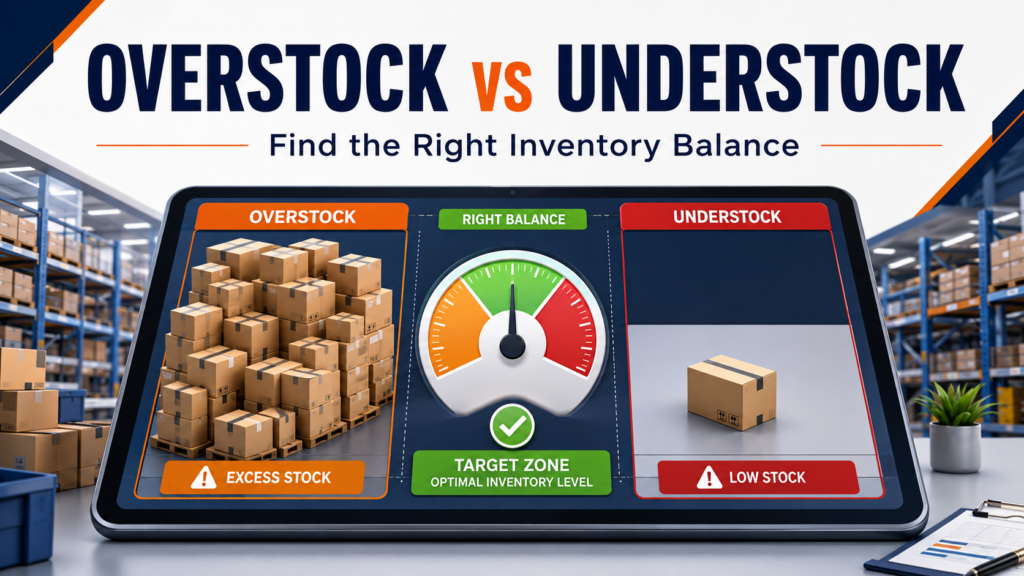
For Amazon FBA wholesale sellers, neither overstock nor understock is simply a warehouse problem. Both can affect cash flow, profitability, advertising decisions, purchasing capacity, and the overall stability of the business.
The goal is not to predict demand perfectly. It is to build a practical inventory system that helps you order the right amount at the right time while leaving enough flexibility for unexpected changes.
Quick Answer: How Can Amazon Sellers Balance Overstock and Understock?
Amazon FBA sellers can balance overstock and understock by tracking sales velocity, calculating realistic lead times, setting SKU-specific reorder points, maintaining appropriate safety stock, and reviewing profitability before placing a wholesale order.
A balanced inventory strategy should include:
- Average daily and weekly sales
- Current sellable inventory
- Inbound and reserved units
- Total supplier-to-Amazon lead time
- Seasonal demand changes
- Product profitability
- Available working capital
- Appropriate safety stock
- A clear reorder point for every important SKU
The ideal inventory level is different for every product. Fast-moving items with stable demand may justify deeper inventory, while new, seasonal, or unpredictable products may require smaller test orders.
What Is the Difference Between Overstock and Understock?
Overstock occurs when a seller holds more inventory than can reasonably be sold within the planned period. Understock occurs when the available inventory is too low to meet expected customer demand.
Both conditions usually result from a mismatch between purchasing decisions and actual sales.
What Is Overstock?
Overstock is excess inventory that remains unsold longer than expected. It may develop when a seller overestimates demand, reacts too strongly to a temporary sales increase, or purchases a large quantity to secure a lower unit cost.
Common signs of overstock include:
- Weeks of cover increasing each month
- Sales slowing while inventory remains high
- Products approaching seasonal decline
- Storage costs reducing expected margins
- Frequent price reductions to generate sales
- Too much working capital concentrated in one SKU
Overstock does not always mean a product is unprofitable. However, the longer inventory remains unsold, the greater the exposure to storage costs, price changes, competition, returns, and changing customer preferences.
What Is Understock?
Understock means there are not enough available units to meet expected demand. A seller may still have some inventory, but the remaining quantity is unlikely to last until the next shipment becomes sellable.
Understock often results from:
- Reordering too late
- Unexpected demand increases
- Incorrect sales forecasts
- Supplier processing delays
- Freight or prep-center delays
- Amazon receiving delays
- Insufficient safety stock
- Counting inbound units as immediately available
- Limited cash for replenishment
Understock can eventually become a complete stockout. Our previous guide explains how to prevent Amazon FBA stockouts during high-demand periods by using sales velocity, reorder points, lead times, and safety stock. This article takes the next step by showing how to avoid solving the stockout problem with excessive inventory.
Why Inventory Balance Matters for Amazon FBA Sellers
Inventory balance affects much more than the number of units stored at Amazon. It influences almost every financial and operational part of a wholesale business.
Overstock Locks Up Working Capital
Every unsold unit represents cash that cannot currently be used elsewhere. If too much money is tied up in a slow-moving product, you may be unable to reorder a faster or more profitable SKU.
A discounted bulk price can look attractive, but a lower unit cost does not automatically make a large order a better investment. Inventory must sell at a suitable price and within a reasonable period for that discount to create real value.
Understock Can Interrupt Sales Momentum
When inventory becomes unavailable, customers may buy from another seller. Advertising campaigns may also lose momentum because an unavailable offer cannot convert traffic into sales.
After restocking, it may take time for the product to return to its previous sales pattern. This is why sellers should reorder before inventory reaches a critical level.
Excess Inventory Can Increase Cost Exposure
Inventory stored for longer periods may create additional expenses and risks, including:
- FBA storage costs
- Aged inventory exposure
- Removal or disposal costs
- Price reductions
- Product damage
- Packaging changes
- Seasonal demand decline
- Reduced profit per unit
Before sending additional units to Amazon, sellers should check current FBA fees and inventory policies for their marketplace because requirements and charges can change.
Poor Stock Planning Can Affect Account Decisions
Urgent inventory shortages sometimes push sellers toward unfamiliar or unverified suppliers. That may lead to incomplete invoices, uncertain product origins, or inconsistent business information.
Maintaining accurate sourcing records can help sellers respond more clearly if Amazon requests information about a product or supplier. Documentation does not guarantee approval, ungating, or acceptance, and requirements may vary by category, marketplace, product, and seller account.
Step-by-Step Guide to Finding the Right Inventory Balance
1. Calculate Average Sales Velocity
Begin by calculating how quickly each product sells.
Average daily sales = Units sold during a period ÷ Number of days
For example, if a product sold 240 units over 30 days:
240 ÷ 30 = 8 units per day
Do not rely only on the previous seven days. Compare several periods:
- Last 7 days
- Last 30 days
- Last 60 or 90 days
- The same season from the previous year
- Periods before, during, and after promotions
Short-term data reflects recent momentum, while longer-term data shows whether that momentum is consistent.
2. Measure Your Weeks of Cover
Weeks of cover estimates how long your available inventory will last at the current sales rate.
Weeks of cover = Available inventory ÷ Average weekly sales
If you have 360 available units and sell 90 units per week, you have approximately four weeks of cover.
This metric makes it easier to compare multiple products. A seller can quickly identify which SKUs have excessive coverage and which may need to be reordered soon.
However, weeks of cover must be interpreted alongside lead time. Four weeks of inventory may be sufficient for a product that can be replenished in ten days, but risky for a product that requires six weeks.
3. Calculate the Complete Replenishment Lead Time
Lead time is not limited to supplier shipping. It should cover the entire period from deciding to reorder until the inventory becomes available for purchase on Amazon.
Include time for:
- Purchase order preparation
- Supplier processing
- Product preparation and labeling
- Shipping to a prep center
- Prep-center handling
- Transportation to Amazon
- Fulfillment center receiving
- Inventory transfers, when applicable
Use a realistic average rather than the fastest shipment you have ever received. Reviewing your actual order history can produce a more reliable estimate.
4. Set a Reorder Point for Each SKU
A reorder point tells you when to place the next purchase order.
Reorder point = Average daily sales × Total lead time + Safety stock
Suppose a product sells eight units per day, requires 24 days to become sellable, and has 48 units of safety stock:
8 × 24 + 48 = 240 units
In this example, the seller should consider reordering when available inventory approaches 240 units.
Do not use one reorder point for an entire catalog. Each SKU has its own sales pattern, lead time, profitability, and supply risk.
5. Add Appropriate Safety Stock
Safety stock is extra inventory held to cover demand changes or replenishment delays.
The amount should reflect:
- Demand consistency
- Supplier reliability
- Shipping variability
- Amazon receiving time
- Seasonal importance
- Product profitability
- Available working capital
- The consequences of running out
A stable product with a short lead time may need a relatively small buffer. A fast-moving product with variable demand and a long replenishment cycle may require more.
Safety stock should not become hidden overstock. Review it whenever sales velocity or lead time changes.
6. Separate Inventory by Status
Do not treat every recorded unit as immediately sellable. Track inventory separately as:
- Available
- Inbound
- Reserved
- Being transferred
- Unsellable
- At a prep center
- Ordered but not shipped
- Confirmed at the supplier
A purchase order is not the same as available stock. Even inventory delivered to an Amazon fulfillment center may take time to be received and distributed.
Your planning sheet should show where inventory is located and its estimated sellable date.
7. Classify Products by Priority
Not every product deserves the same purchasing budget or inventory depth. A simple ABC approach can help:
- A products: Important SKUs with consistent sales, suitable profitability, and frequent replenishment needs
- B products: Moderate sellers that require regular but less intensive monitoring
- C products: Slow, new, seasonal, or unpredictable products that may need smaller orders
This classification helps prevent low-priority inventory from consuming cash needed for stronger products.
8. Use Smaller Test Orders for New Products
New sellers often overorder because they expect early sales to continue indefinitely. A product may perform well for several days because of a promotion, temporary ranking change, competitor stockout, or advertising increase.
For a new product:
- Begin with a manageable test quantity
- Monitor sales and price movement
- Review fees and actual profit
- Confirm return patterns
- Evaluate competition
- Increase order size gradually when demand becomes clearer
Smaller test orders may have a higher unit cost, but they can reduce the financial risk of committing heavily to an unproven SKU.
9. Review Profitability Before Every Reorder
A product selling quickly is not necessarily a strong reorder opportunity. Before purchasing more inventory, review:
- Wholesale cost
- Amazon fees
- Inbound freight
- Prep and labeling costs
- Advertising expenses
- Expected selling price
- Return exposure
- Storage considerations
- Net profit per unit
- Expected inventory turnover
If margins have fallen, a smaller order—or no reorder—may be more sensible than protecting sales volume at any cost.
For a deeper look at demand-based purchasing, review the guide to Amazon FBA inventory forecasting using sales data.
10. Set Minimum and Maximum Stock Levels
A minimum level alerts you when a reorder is needed. A maximum level helps prevent excessive purchasing.
Your maximum level should consider:
- Expected demand during the planning period
- Supplier minimum order quantity
- Storage capacity
- Product shelf life
- Seasonal demand
- Available working capital
- Target inventory turnover
These limits should guide decisions, not operate as permanent rules. Update them as sales patterns and replenishment times change.
11. Consider Staggered Reordering
Instead of placing one large order, sellers may divide inventory into smaller scheduled purchases or shipments when supplier terms and freight costs make this practical.
Staggered orders may provide:
- Better cash-flow control
- Lower exposure to declining demand
- More opportunities to update forecasts
- A steadier flow of inbound inventory
- Less dependence on one shipment
This method will not suit every product. Minimum order quantities, case packs, shipping rates, and supplier availability must be considered.
Common Inventory Mistakes to Avoid
Ordering Based on Instinct
A product may feel popular without having consistent sales data. Purchasing decisions should be based on actual velocity, profitability, and lead times.
Assuming High Sales Will Continue
A temporary increase may result from a promotion, season, competitor stockout, or advertising change. Compare recent performance with longer sales periods before increasing an order significantly.
Buying More Only to Receive a Discount
A lower wholesale price is valuable only when the additional inventory sells profitably. Calculate the total cash commitment and likely sell-through period before accepting a volume discount.
Ignoring Slow-Moving Inventory
Review slow products regularly. Possible responses may include adjusting advertising, improving the offer, reducing future purchase quantities, or evaluating appropriate removal options.
Counting Inbound Inventory as Available
Inbound units can be delayed in transit or during Amazon receiving. Monitor them separately until they become sellable.
Using the Same Safety Stock for Every Product
Products have different demand patterns and supply risks. Give each important SKU its own buffer.
Reordering Without Checking Current Profit
Fees, competition, advertising costs, and selling prices can change. Recalculate the expected margin before every significant reorder.
How a Verified Wholesale Distributor Can Help
A verified wholesale distributor cannot predict demand or prevent every stockout. However, a dependable sourcing relationship can make inventory planning more organized.
Working with a legitimate distributor can help sellers:
- Source authentic wholesale products
- Confirm product and case-pack information
- Understand order requirements
- Plan around current availability
- Maintain commercial purchasing records
- Receive invoices for completed wholesale orders
- Build a repeatable replenishment process
- Keep better sourcing documentation
Accurate invoices and supplier records may help support approval requests depending on Amazon’s requirements. They do not guarantee ungating, account approval, or document acceptance. Requirements may vary by category, product, marketplace, and seller account.
You can learn more about the company’s sourcing approach on the About Nations Distributor page. You can also visit Nations Distributor to check available product categories and wholesale information.
The same inventory principles apply beyond Amazon. Businesses managing dealership or retail inventory can also benefit from balancing product availability with storage and working-capital limits, as discussed in the guide about how wholesale distribution can support dealership profitability.
Final Thoughts
Finding the right balance between overstock and understock requires regular review rather than a one-time calculation.
Start with a practical system:
- Track average sales velocity
- Measure weeks of cover
- Calculate complete replenishment time
- Set a reorder point for each important SKU
- Maintain appropriate safety stock
- Separate available and inbound units
- Review profitability before reordering
- Use smaller orders for uncertain products
- Update your forecast as conditions change
No inventory plan can remove every uncertainty. The objective is to make informed purchasing decisions, protect working capital, and give your business enough time to respond when demand or supply conditions change.
If you are ready to explore authentic wholesale products, you can apply for a wholesale account. For questions about product availability, order requirements, or wholesale documentation, contact Nations Distributor before planning your next purchase.
Frequently Asked Questions
1. What is the main difference between overstock and understock?
Overstock means holding more inventory than you can reasonably sell during the planned period. Understock means having too few units to meet expected demand before replenishment arrives.
2. How can Amazon FBA sellers avoid overstocking?
Track sales velocity, measure weeks of cover, use smaller test orders, set maximum stock levels, and check profitability before every reorder. Avoid increasing order quantities based only on short-term sales spikes.
3. How do I calculate an Amazon FBA reorder point?
Use this formula:
Reorder point = Average daily sales × Total replenishment lead time + Safety stock
Recalculate it whenever demand, supplier processing time, shipping, or Amazon receiving time changes.
4. How much safety stock should an Amazon seller keep?
The right amount depends on demand variability, lead time, supplier reliability, seasonality, and available cash. Fast-moving or difficult-to-replenish products may need a larger buffer than stable products with short lead times.
5. Can wholesale invoices help with Amazon approval requests?
Legitimate commercial invoices can help sellers keep better sourcing records and may help support approval requests depending on Amazon’s requirements. However, invoices do not guarantee ungating, approval, or acceptance.