
Amazon FBA Inventory Planning for Wholesale Sellers: Complete Guide
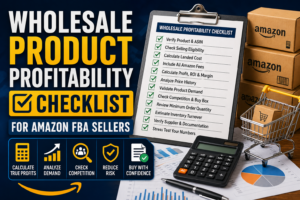
Running an Amazon wholesale business is not simply about finding a profitable product and sending as many units as possible to FBA. One of the biggest ongoing challenges is deciding how much inventory to purchase, when to reorder, and how to keep enough stock available without tying up too much cash. Order too little and you may run out of stock while a product is selling well. Order too much and capital can become trapped in slow-moving inventory while storage and other inventory-related costs continue to accumulate. That is why Amazon FBA inventory planning should be treated as a core part of wholesale sourcing rather than something you think about after placing an order. A practical inventory plan combines sales demand, supplier lead times, existing stock, inbound units, seasonality, cash flow, and Amazon-specific considerations. When these factors are reviewed together, wholesale sellers can make purchasing decisions based on evidence rather than guesswork. If you are still deciding which wholesale products deserve your capital, start with our guide on how to evaluate wholesale product demand without guesswork before building your inventory plan. How Should Amazon FBA Sellers Plan Inventory? Amazon FBA wholesale sellers should plan inventory by estimating expected sales, calculating days of supply, monitoring supplier lead times, setting reorder points, and maintaining appropriate safety stock. A basic process looks like this: The objective is not simply to keep the maximum possible inventory in FBA. It is to maintain enough appropriate inventory at the appropriate time while protecting working capital. What Is Amazon FBA Inventory Planning? Amazon FBA inventory planning is the process of estimating how much inventory a seller will need and deciding when additional wholesale stock should be purchased and replenished. For a wholesale seller, inventory usually moves through several stages: Distributor → Seller or Prep Location → Amazon FBA → Customer Each stage takes time. This means an Amazon seller cannot wait until the final few units are left before placing another wholesale order. By the time the distributor processes the order, inventory is prepared, products are shipped, and Amazon receives the shipment, the existing stock could already be depleted. Effective inventory planning attempts to keep these timelines synchronized. The Main Components of an FBA Inventory Plan A useful inventory plan should consider: These factors are connected. Looking at only one number, such as last month’s sales, rarely provides enough information for a good purchasing decision. Why Inventory Planning Matters for Amazon FBA Wholesale Sellers Wholesale sellers often purchase products in larger quantities than retail arbitrage or online arbitrage sellers. As a result, an inventory mistake can affect a larger portion of the seller’s working capital. Consider a simple example. Suppose a product sells approximately 10 units per day and you currently have 300 sellable units. At the current sales rate: 300 units ÷ 10 units per day = approximately 30 days of supply Thirty days may initially sound comfortable. However, imagine your complete replenishment cycle—from placing a distributor order to having sellable units available at Amazon—takes around 20 days. You effectively have only about 10 days of additional inventory coverage before the replenishment timeline becomes tight. This is why inventory should be measured in days of supply, not only in total units. Inventory Planning Helps Protect Cash Flow Every unit sitting in inventory represents money that cannot immediately be used elsewhere. Overordering one SKU may prevent you from purchasing another attractive product or replenishing a faster-moving ASIN. Good inventory planning helps sellers balance two competing objectives: Availability: Keep enough inventory to support expected customer demand. Capital efficiency: Avoid purchasing significantly more inventory than the business can reasonably sell within the planned period. Before committing capital to a reorder, it is also useful to run the product through a profitability review. Our wholesale product profitability checklist for Amazon FBA sellers covers the major factors sellers should examine before increasing inventory exposure. Step-by-Step Amazon FBA Inventory Planning Guide Step 1: Calculate Your Current Sales Velocity Start by determining how quickly the product is actually selling. A simple calculation is: Average Daily Sales = Units Sold ÷ Number of Days For example, if you sold 240 units during the previous 30 days: 240 ÷ 30 = 8 units per day Do not automatically assume that eight units per day will continue indefinitely. Compare multiple periods when sufficient data is available, such as: This helps you identify whether sales are increasing, decreasing, stable, or being temporarily affected by a promotion or seasonal event. Step 2: Calculate Days of Supply Next, determine approximately how long your available inventory will last. Use: Days of Supply = Available Inventory ÷ Average Daily Sales If you have 400 units available and sell eight units per day: 400 ÷ 8 = 50 days of supply This number is much more actionable than simply knowing you have 400 units. Step 3: Determine Your True Replenishment Lead Time One common mistake is counting only the distributor’s shipping time. Your actual lead time may include: If the supplier ships in five days but the entire process takes 18 days, your inventory planning should be based closer to the full 18-day cycle, not five days. Keep records of actual lead times for each supplier. Real historical performance is generally more useful for planning than assuming every future order will follow an ideal timeline. Step 4: Establish a Reorder Point Your reorder point tells you when it is time to begin replenishment. A simple model is: Reorder Point = Expected Demand During Lead Time + Safety Stock Assume: Expected lead-time demand: 8 × 20 = 160 units Reorder point: 160 + 80 = 240 units Under this simplified example, you would consider reordering when inventory approaches approximately 240 units. The appropriate safety stock will vary by product, supplier reliability, sales volatility, seasonality, and the seller’s risk tolerance. Step 5: Account for Inbound Inventory Do not treat inbound units as if they do not exist, but do not treat them exactly like immediately sellable FBA inventory either. For example: On paper,